Top Mobile App Development Trends for 2026
Mobile Apps in 2026 are not similar to what they were a few years back, as technological advancement is moving much faster than ever. From AI that personalizes user experience to Super Apps bringing the entire ecosystem under one application, it is no longer enough for businesses to consider a one-time build for app development.
User expectations are increasing, technology is moving more rapidly, and the price of falling behind is higher for businesses. Whether you are working on a new app development project or an existing one, it is important to know the right direction with expected goals.
This blog helps you to understand the top mobile app development trends in 2026, including how they affect your company, where your resources should be prioritized, and how to pick the best partners to develop your ideas into reality.
Why Does Staying Ahead of App Development Trends Matter for Businesses?
With innovative mobile app trends in 2026, businesses can retain satisfied customers, beat competitors, and save money. They can implement advanced technologies, like AI, to build apps that run faster, ensure simplified layouts, and increase sales. Additionally, they can be fixed easily, providing affordability and reduced time for developers.
1. Meeting Rising User Expectations and Retention
The first thing that a business investor must do is fulfill various user demands to easily retain them in the future. Some of the major points are discussed in this section that they must consider before starting.
- Faster, Smoother Performance: Users expect apps to run and load quickly even from a less responsive device and over an unreliable network. If apps become slow by seconds, then the user may shift to another app that serves faster.
- Personalized, Relevant Experiences: People want apps to understand them and customize content, suggestions, and features accordingly. Unchanged and generic experiences feel out of date and will reduce the number even quicker.
- Seamless Cross-Device Continuity: Users move seamlessly between mobile, tablet, and wearable, expecting similar experiences. Apps that are not connected across devices rapidly fall out of day-to-day trust and use.
2. Gaining a Competitive Edge in a Crowded App Market
It is highly beneficial to understand the current market situation and technical requirements before moving forward. This helps to easily deliver standard digital products that ensure consistent growth.
Standing Out in Saturated App Stores: As millions of applications are released daily, early adopters will set their brand apart from similar businesses. The more prominent a new app feature is, the greater the impact it will have on app downloads and visibility.
Capturing Early-Mover Advantage: Companies that adopt the latest trends before competitors gain customers’ trust faster. It will be difficult for rivals to attract users to switch, even through mobile app monetization, once they are used to a better app experience.
Strengthening Brand Perception as Innovative: Technically advanced apps appear more credible and modern, providing greater trust to users. This affects acquisition rates, positive word-of-mouth, and long-term equity in the highly saturated market.
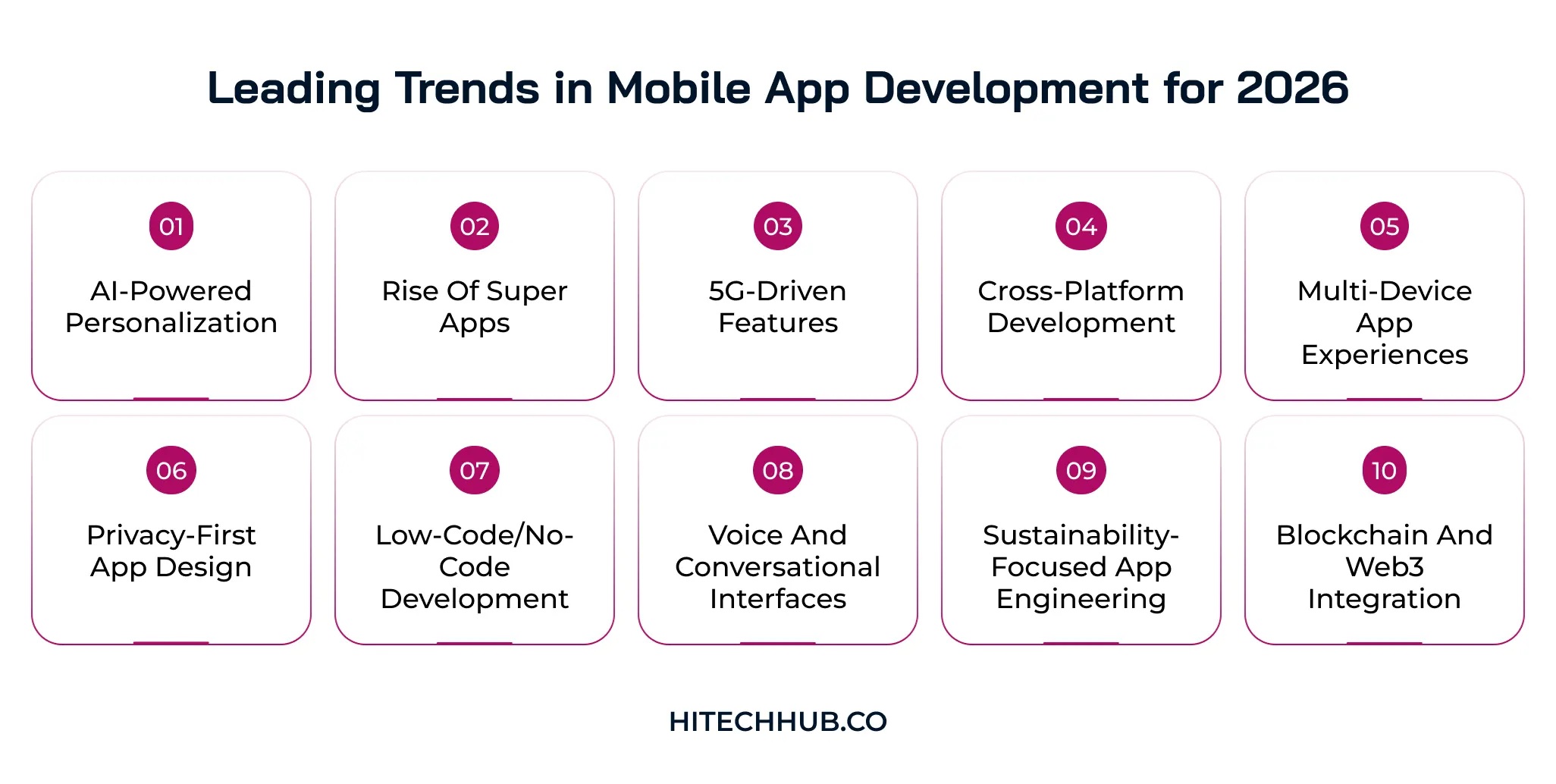
Leading Trends in Mobile App Development for 2026
This section discusses the top app development trends for businesses, such as AI integration, 5G connectivity, and low-code/no-code tools. Here, you will understand each one of them with detailed information and a specific use case.
1. AI-Powered Personalization
Earlier, AI was limited to recommending things, but it will now control application layouts, content, and features. Additionally, in 2026, mobile apps can easily predict user needs and growing product demand before customers ask for them.
Use Case: Shopping apps that rearrange their homepage based on individual browsing patterns.
2. Rise of Super Apps
In super app development, various features ranging from payments, messaging, bookings, and shopping are integrated to eliminate the need to switch between several applications. The trend, adopted by companies, is helping them increase engagement and reach out to millions of users.
Use Case: Ride-sharing apps that offer food delivery and bill payments within the same platform.
3. Cross-Platform Development
Various React Native and Flutter app development frameworks are used widely because most investors want cross-platform solutions for iOS and Android platforms. It helps to reduce development time and cost efficiently without affecting the overall performance or user experience.
Use Case: Startups are launching an MVP on both app stores using a single Flutter codebase.
4. 5G-Driven Features
As 5G network adoption increases, mobile apps can easily deliver more real-time content like HD live video streaming, AR experiences, or instant data sync. This growing trend leads to 5G mobile app features that were previously unreachable due to bandwidth limitations.
Use Case: An AR-based furniture app letting users visualize products in their home instantly.
5. Multi-Device App Experiences
As the demand for foldables, smartwatches, and tablets is rising, mobile apps are built for various device types and screen sizes. This goes beyond single-device experiences, allowing developers to easily create flexible and responsive interfaces.
Use Case: Fitness apps syncing workout data between a smartwatch and a foldable phone display.
6. Privacy-First App Design
With increased scrutiny of user data and strict regulations, multiple mobile apps are developed with strong privacy controls, encrypted data, and clear data usage guidelines. These mobile app security trends are increasingly being treated as a necessary trust builder rather than compliance.
Use Case: Healthcare applications offering users full control over personal data sharing and storage.
7. Low-Code/No-Code Development
Creating applications with low-code/no-code app development is becoming an efficient process with little or no human coding needed, particularly for internal applications and MVPs. Businesses are adopting this trend to reduce overhead expenses and dependency on inefficient teams.
Use Case: A small business building an internal inventory management app without a dedicated dev team.
8. Voice and Conversational Interfaces
Voice command and AI-powered chatbots are emerging rapidly, allowing users to access various types of mobile applications with hands-free and natural experiences. These trends are well suited for iOS app development, which has a growing mobile space and convenient use cases across industries.
Use Case: Smart home applications allowing users to control devices entirely through voice commands.
9. Sustainability-Focused App Engineering
Most developers optimize mobile apps to ensure lower energy consumption and efficient resource use that align with broader corporate sustainability goals. This “green coding” approach also improves app performance and battery efficiency for users in real-time.
Use Case: A media-streaming app reducing background data usage to lower device energy consumption.
10. Blockchain and Web3 Integration
Blockchain is moving into mainstream apps to enable secure transactions, digital ownership, and transparent record-keeping beyond just crypto platforms. Businesses are exploring this to build trustworthy platforms for users and open new revenue models.
Use Case: Gaming apps using blockchain to let users truly own and trade in-game assets.
Trends Comparison at a Glance
Let’s compare all these trends in this section to get a quick overview of what we have learned about various technical innovations. This will help you to develop an app based on your requirements, such as budget, future goals, and business use case. The following table also helps investors to decide whether they should adopt a particular trend or not.
| Trend | Business Impact | Ideal For | Adoption Urgency |
| AI-Powered Personalization | Boosts engagement through tailored user experiences | Retail, media, fintech apps | High |
| Rise of Super Apps | Increases retention via bundled services | Platforms with multiple use cases | Medium |
| Cross-Platform Development | Cuts costs and speeds up time-to-market | Startups, MVPs, lean teams | High |
| 5G-Driven Features | Enables richer, real-time app experiences | Gaming, AR/VR, streaming apps | Medium |
| Multi-Device App Experiences | Improves accessibility across foldables, wearables | Consumer-facing, lifestyle apps | Medium |
| Privacy-First App Design | Builds user trust and ensures compliance | Healthcare, fintech, regulated industries | High |
| Low-Code/No-Code Development | Reduces development time and technical overhead | Startups, internal business tools | Medium |
| Voice and Conversational Interfaces | Enhances hands-free, accessible interactions | Smart devices, e-commerce, utilities | Low |
| Sustainability-Focused App Engineering | Lowers energy costs and appeals to eco-conscious users | Enterprise, consumer brand apps | Low |
| Blockchain and Web3 Integration | Adds transparency and secure transaction layers | Fintech, gaming, digital ownership apps | Medium |
How Do These Trends Impact Your App Development Budget & Timeline?
AI infrastructure, cross-platform services, and low-code tools reduce development time and cost for businesses. Shifting security planning and cloud integration to the initial phase may increase the upfront cost but avoid expensive post-launch fixes. No-code platforms accelerate prototyping, which can reduce the timeline with fundamental tools and rapid testing.
1. Cost implications of adopting new tech stacks
Modern trends affect mobile app development costs in 2026 on a large scale, impacting multiple market factors. A few of the major aspects are discussed in this section and commonly identified among investors.
- Higher initial investment: New technologies involve the cost of purchasing new tools, new licenses, or a complete rewrite of current infrastructure.
- Increased hiring or training costs: Skilled developers experienced in developing with a young tech stack cost much higher rates and require training otherwise.
- Long-term maintenance savings: Modern scalable tech stacks reduce the technical debt cost of refactoring the existing code.
2. Build vs. partner: when to bring in a specialized agency
Whether you want to invest in Android app development or hybrid services, it is crucial to understand the difference between a custom build and a partnering agency. This section provides a table that differentiates the two aspects and describes their key metrics.
| Parameter | Build In-House | Partner with a Specialized Agency |
| Cost Structure | Higher upfront cost for hiring, tools, and infrastructure | Predictable project-based or retainer pricing |
| Time to Market | Slower due to hiring, onboarding, and ramp-up time | Faster launch with an already skilled, ready team |
| Access to Expertise | Limited to existing team skill sets | Immediate access to specialized trend-specific expertise |
| Scalability & Flexibility | Harder to scale quickly for short-term needs | Easily scales resources up or down per project phase |
How to Choose the Right Development Partner for 2026-Ready Apps?
An enterprise must evaluate the expertise of a team in artificial intelligence (AI) integration, cloud-native architecture, and data security compliance. Additionally, it is important to test the experts for effective communication and business ethics to ensure product credibility. In this section, we will focus on some strategies that you should follow while hiring development teams.
1. Key skills/technologies to look for in an agency
Teams must have good experience in using an advanced mobile app tech stack to ensure smooth design and seamless API and database integration across devices. Businesses must keep the following things in mind while hiring experts.
- AI and machine learning expertise: This helps to ensure the agency can build smart and personalized app features.
- Cross-platform development proficiency: Enterprises must look for strong experience in Flutter, React Native, or similar frameworks.
- Security and compliance knowledge: It is crucial to confirm the agency follows data privacy and industry regulations.
- UI/UX and emerging tech adaptability: This shows the agency can design for foldables, wearables, and new interfaces.
2. Questions to ask before hiring
Entrepreneurs must ask a few questions to development teams regarding post-launch support and process before hiring them. Here, a few queries are discussed that every investor must ask their app-making partners.
- What’s your experience with similar apps? — It reveals whether they understand your industry and use case.
- How do you handle post-launch support? — This clarifies ongoing maintenance, updates, and bug-fix processes.
- Can you share client references or case studies? — The answer can validate their track record and reliability.
- What’s your process for scope and timeline changes? — It sets expectations for flexibility and communication during the project.
Conclusion: Preparing Your App Strategy for 2026
AI, cross-platform efficiency, and a privacy-first design are key trends dominating in 2026. Additionally, technologies such as 5G and Web3 offer exciting new possibilities and will shape the future of mobile app development. It is not only important to ensure business innovation but also to keep up with user expectations and gain market share in today’s competitive app arena.
Businesses must align their budget and strategies with these emerging trends while building and redesigning their app for 2026. They can find proficient and forward-thinking app development companies at the HiTech hub to successfully pave the way for substantial growth.
FAQs
What role do AR and VR play in 2026 mobile apps?
AR/VR technology acts as a practical and AI-driven tool in mobile applications, not just a visual innovation. It is applied to various industries, like retail, gaming, education, and healthcare. Major use cases include virtual try-ons, live map navigation, real-world play, and medical simulation.
Are cross-platform frameworks still preferred over native apps?
For most standard business applications, content-heavy apps, and startups, cross-platform frameworks are used. But a hybrid architecture that combines cross-platform with native services is adopted widely for premium products. Kotlin Multiplatform (KMP) is highly recommended by experts for shared logic and native UI
Why should businesses invest in progressive web apps (PWAs)?
Businesses invest in progressive web apps, as they ensure a fast and engaging feel of a native mobile app on a website. Some of the major benefits of PWAs include lower costs, instant speed, and no app store limitations. It also provides offline functionality, better user engagement, and search engine discovery.
How are developers addressing mobile app security and privacy?
The experts ensure multi-layered strategies for data storage, network communication, authentication, and continuous testing. They use AES to protect data and cryptographic key stores for secure management. Various protocols like HTTPS and TLS 1.2 protect transmitted data, reducing the probability of threats.
Why should traditional businesses prioritize a mobile-first strategy?
As most consumers use smartphones for browsing and purchasing products, it is beneficial to prioritize a mobile-first strategy. Businesses must know consumer behavior to increase engagement and gain competitive advantage. They should focus on user-specific design to improve scalability and increase retention.

Eshika Jain
14-September-2026
Top Categories

NEED HELP SELECTING A COMPANY?
With the fast-paced world of web development today, keeping pace.
Connect With Us