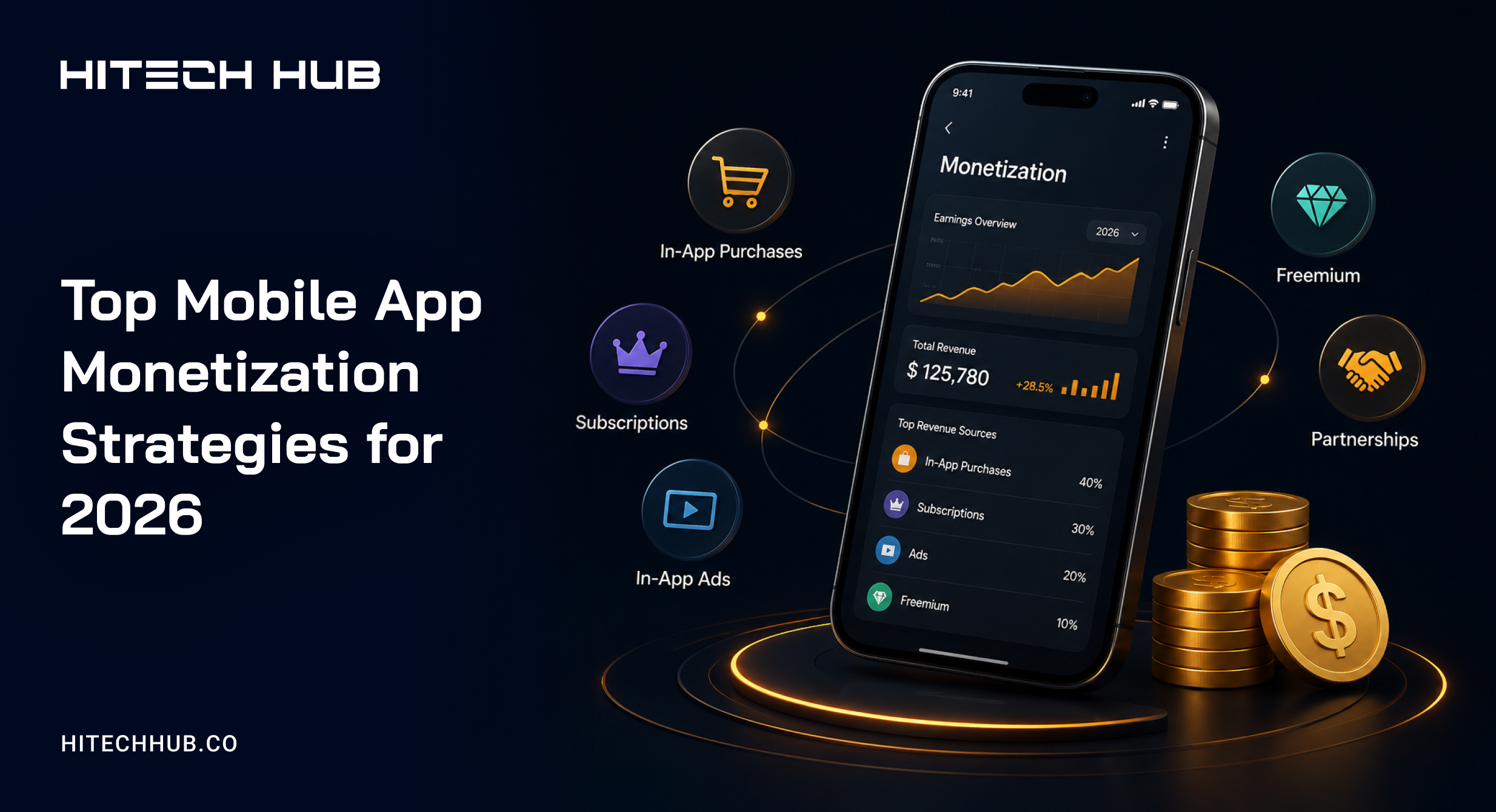
Top Mobile App Monetization Strategies for 2026
Developing a future-ready mobile application is quite necessary, but converting user engagement into sustained revenue streams is what most businesses fail at.
Rising customer acquisition costs, strict privacy compliance, and evolving consumer expectations show that the mobile app monetization methods adopted in the past will not be efficient in the year 2026 and beyond.
Today’s leading digital platforms may not rely on a single source of income, as they are deploying targeted and user-focused strategies to ensure maximum monetization.
This article discusses all the strategies that startup founders or large enterprises want to identify to support scalability for tested applications, maximizing the income streams.
Why Monetization Strategy Matters More Than Ever in 2026?
In 2026, mobile app domination is going to be tough, with thousands of new apps launching each day, each matching its target users’ attention.
An app that simply functions and looks nice is no longer sufficient to command significant income and satisfy investors. Businesses that do not make revenue through product-selling strategies but merely add some income will surely lag behind.
The shift from downloads to lifetime value (LTV)
A higher acquisition cost may lead to expensive mobile app downloads. So, the app owners in 2026 are now changing their focus towards long-term and sustainable revenue.
- High CPIs mean it pays off more to keep users than to acquire them over and over.
- Apps with LTV in mind focus on an onboarding process that fosters long-term habit formation and engagement.
- Personalized offers, coupled with proactive upsells or renewals, replace a single offer to convert.
- Reducing churn is being viewed as not only a support metric but also a strategy that drives revenue.
- Stakeholders and investors are analyzing growth using LTV and retention curves rather than by sheer volume of downloads.
Role of user expectations and app store policies
Users expect transparency, value, and control, which can expose hidden monetization tactics. Also, strict app store guidelines affect revenue models, allowing developers to implement user-first models.
- Users will continue ditching apps with aggressive ad campaigns and fuzzy subscription policies.
- App Store & Google Play will continue to tighten rules on subscription disclosures and cancellations.
- Privacy restrictions monetize your app through exclusive content and data tracking.
- Dark patterns in freemium pricing will continue to get scrutiny from both platforms and users.
- Getting a positive rating in the app store is going to be tied directly to the fairness of your monetization.
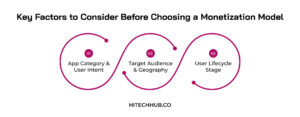
Key Factors to Consider Before Choosing a Monetization Model
To monetize applications, investors must consider various factors before choosing a particular model. This helps them to identify business needs, market demand, and overall value after implementation.
-
App Category and User Intent
The app category is a major indicator of whether a given monetization approach will work, based on paid or free users, contributing differently to revenue.
A gaming app can take advantage of in-app purchases and transactions with virtual goods, whereas a utility or productivity app is better for targeting subscribers.
-
Target Audience and Geography
People in wealthy countries with higher incomes can easily spend more than others on products, so a single payment option will often not be useful across regions.
For example, you can monetize mobile applications and achieve a higher subscription rate on an app in the USA than in a price-sensitive country.
-
User Lifecycle Stage
A monetization strategy is affected by user acquisition, retargeting previous users, or maximizing lifetime value. For example, a newly developed mobile app offers its services for free in the beginning to attract customers, but it can switch to subscription models as the user base grows.
| App Category | Best-Fit Model(s) |
| Gaming | IAP, Microtransactions, Hybrid |
| Productivity/Utility | Subscription, Freemium |
| Social/Content | Ads, Freemium, Community |
| eCommerce/On-Demand | Affiliate, Commission-based |
| Health & Fitness | Subscription, Freemium |
| Education/eLearning | Subscription, Community/Membership |
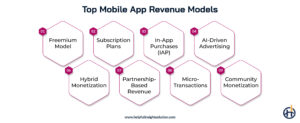
Top Mobile App Revenue Models
Knowing different ways to monetize apps helps business investors understand their work and applicability. In this section, we will explore 8 major revenue-generating strategies common in 2026.
1.Freemium Model with Smart Feature Gating
With the freemium model, businesses deliver free features, however limits the core functionality behind the paywall, allowing users to upgrade in the future.
They put smart gating on the most value-providing features for consistent engagement and convert paying users in the long run.
Spotify: Free and ad-supported in its basic package, but it unlocks offline downloads and eliminates ads with Premium.
2. Subscription-Based Monetization
This model charges customers at fixed intervals for accessing app features and content according to their monthly or annual plans.
It works best for apps such as fitness coaching or time management tools that offer recurring value, generating stable income and ensuring long-term customer relationships.
Headspace: Users need a paid subscription to access all their meditation and sleep content, monthly or annually.
3. In-App Purchases (IAP) and Virtual Goods
This is the most common revenue model that charges a one-time fee, allowing users to buy virtual items, in-app upgrades, or extra features.
Various gaming apps use this monetization strategy because users spend real money on visual customization, power-ups, or additional content.
Candy Crush Saga: With in-game purchases, players can buy additional lives, boosters, and currency to move through stages more quickly.
4. AI-Personalized Advertising
AI can easily personalize ads for customers based on individual data, machine learning algorithms, and increased user interest in a particular feature.
This technology helps businesses to balance the ad revenue of free apps and offer a good overall experience to users and advertisers.
Instagram: It uses AI to deliver ads for products based on user interests, navigation, and engagement with the platform.
5. Hybrid Monetization
Hybrid monetization involves the integration of several income strategies, such as advertising, in-app purchases, or subscriptions, which diversifies the revenue sources.
It minimizes reliance on a single model and targets various users, from ad-based customers to those who pay for advertisement-free experiences.
YouTube: Made up of a mix of ad income, YouTube Premium subscriptions, and direct payments to creators for channel memberships.
6. Affiliate and Partnership-Based Revenue
This mobile app monetization strategy involves promoting third-party products or services inside the app and earning a commission on generated sales or sign-ups.
This method is suitable for content-based or comparison applications where recommending the products adds value in the app for the user.
Skyscanner: Gets a commission when you make a booking with a travel, hotel, or airline site from its app.
7. Micro-Transactions and Usage-Based Billing
Micro-transactions cost users small amounts of money that depend on usage and action, which work well for apps offering various AI services and vary between individual consumers.
As this model states, usage pricing guarantees that users pay for the amount they use, resulting in equitable and adjustable costs.
ChatGPT: Fees are based on the number of tokens of each of the input and output messages processed per request to their API.
8. Community/Membership Monetization
Membership monetization charges consumers for subscribing to exclusive services, such as groups and communities, or for engaging with special networking features.
It is suitable for niche-specific apps whose users share common interests, encouraging them to stick to services beyond pure product price.
Strava: Membership fees enable access to enhanced training analytics and segment leaderboard tracking for individual athletes.
| Model | Best For | Pros | Cons |
| Freemium | Startups, wide user base | Low entry barrier | Low conversion rate |
| Subscription | SaaS, fitness, content apps | Recurring revenue | Requires strong retention |
| IAP | Gaming apps | High revenue potential | Can feel pay-to-win |
| AI-Personalized Ads | Free/social apps | No cost to the user | Ad fatigue risk |
| Hybrid | Most app types | Diversified revenue | Complex to manage |
| Affiliate/Partnership | Content, comparison apps | Passive income | Dependent on traffic |
| Microtransactions | Utility, AI tools | Scales with usage | Unpredictable revenue |
| Community/Membership | Niche, loyal audiences | High LTV | Slower to scale |
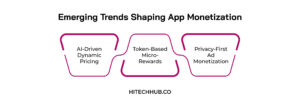
Emerging Trends Shaping App Monetization
There is a sudden rise in technical innovations for mobile application monetization, such as AI and blockchain. They ensure more user engagement, increased returns, and an edge over other competitors.
-
AI-Driven Dynamic Pricing
Apps using this technology can dynamically adjust the pricing of subscriptions, in-app purchases, or offers in response to a user’s activity, engagement, and payment propensity.
This can easily maximize revenue per user by providing a personalized pricing structure rather than a fixed rate.
-
Web3, NFTs, and Token-Based Micro-Rewards
This trend enables mobile apps to reward users with digital tokens based on overall engagement and enables them to trade, redeem, or spend these tokens for premium features.
These tools are used in mobile game monetization and community apps that aim to build brand loyalty.
-
Privacy-First Ad Monetization
The changes in third-party cookies for iOS app monetization allow apps to focus on on-device targeting and contextual advertising instead of tracking users.
This helps investors to increase ad revenue by ensuring users’ interests, building trust with end-users, and complying with strict privacy guidelines.
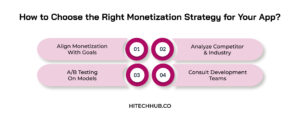
How to Choose the Right Monetization Strategy for Your App?
For choosing the right mobile app monetization strategy, it is crucial to follow a process that is applicable at all business levels. This section provides key steps, from goal mapping to expert consultation, ensuring scalability.
-
Align monetization with goals
This should align with the goals of your application, such as increasing user acquisition, maximizing revenue through Android app monetization, and ensuring user engagement.
You don’t want a model that goes against your core objective, like having intensive ads on an app that promises itself to be premium.
-
Analyze competitor & industry
It helps to understand what may and may not work rather than guessing about which model will be sustainable. Trends from competitors or those in your niche will let you know about general user expectations in terms of price, the level of advertising, and your free-to-paid-user conversions.
-
A/B testing on models
Testing with real user segments provides true validation of what really causes revenue conversion, instead of guessing. Conducting proper A/B tests allows businesses to optimize for pricing, feature gating, ad placement, or other mechanisms in their strategy based on real data performance.
-
Consult development teams
Monetization decisions have various technical implications for how feature gating, subscription mechanics, or payment integrations will be implemented.
By hiring development teams to validate monetization models, enterprises can easily ensure feasibility, scalability, and cost-effectiveness.
Common Mistakes to Avoid in App Monetization
It is important to understand the different mistakes that most enterprises make while they monetize applications. Whether they choose subscription, freemium, or app ad monetization methods, knowing these errors helps them to boost user engagement and maintain consistency.
Here are some key points that investors must consider before creating mobile apps.
- Over-monetizing: Introducing aggressive paywalls early in the funnel before users feel value, which churns the overall revenue base.
- Ignoring regional differences: Using a single world price fails to recognize buyer willingness in different price tiers and causes revenue leakage in price-sensitive markets.
- Overloading intrusive ads: Too many ads will affect the user experience and downgrade the install base, even if they really drive more short-term ad revenue.
- Relying on a single model: Reliance solely on advertising, IAP, or any other model causes the app to be not resistant to changes in user preference or platform policies.
- Skipping A/B testing: Not testing out various monetization approaches can cause users to leave, affect conversion rates, and decrease revenue.
Conclusion!!
Mobile app monetization is not a single strategic decision because its success involves constant testing, analyzing user behavior, and utilizing technical functionalities.
From implementing freemium models to creating subscription-based services or a hybrid strategy, businesses can monetize mobile apps.
By partnering with experienced teams, investors can understand the difference between the revenue model that seems good on paper and one that actually scales. Examine
Hitech Hub’s handpicked list of top mobile app development companies and find a match for your venture.
FAQs
Which monetization model works best for startups with a limited budget?
Startups with limited budgets can implement a freemium model, which requires minimal upfront investment. This mobile app monetization strategy helps businesses generate revenue from premium features that are unlocked through in-app upgrades. It also provides real usage data to refine paid tiers before scaling other plans.
Is the subscription model still effective for mobile apps in 2026?
Apps that offer fitness tracking, productivity tools, or content guides use tiered subscription models to generate revenue. It helps businesses get predictable recurring income and increase customer lifetime value.
For success, they must communicate ongoing value so users don’t leave the platform after the first billing cycle.
What’s the difference between in-app purchases and microtransactions?
In-app purchase (IAP) is a one-time or recurrent transaction that involves buying a virtual item or unlocking premium features. Microtransactions are typically small, recurring, and driven by use that can be experienced in games or AI-based applications. It is also a type of IAP, but it focuses more on repeat purchasing rather than a single purchase.
How to monetize a free app without affecting user experience?
Businesses should select monetization strategies that focus on AI-tailored advertising or affiliate promotions. Use ad placements and frequencies wisely so they don’t disrupt major app features or navigation paths.
It is crucial to perform A/B test approaches and gather feedback to ensure revenue generation and long-term engagement.

Eshika Jain
04-September-2026
Top Categories

NEED HELP SELECTING A COMPANY?
With the fast-paced world of web development today, keeping pace.
Connect With Us