Mobile App Development: Process, Cost, and Challenges
Mobile applications have been established as a major channel of communication for companies to reach out to potential customers, generate leads, and boost sales in the digital marketplace.
The current mobile app market value is $322.6 billion in 2026, which will reach $885.3 billion by the end of 2033 at a 15.5% CAGR rate.
For all, whether they are startups or large enterprises, it is necessary to understand mobile app development services. This makes it easy for them to arrive at concrete decisions that can turn their concept into a profitable and viable end product.
In this blog, we are going to explore various aspects, like mobile app types, development process, tech stack, challenges, and cost. So, stay tuned to get more valuable insights in detail.
What is Mobile App Development?
Mobile application development is the process of creating software that can run on various mobile devices, primarily focusing on Android and iOS platforms.
Developers may use advanced technologies like AI, cloud computing, and AR/VR to enhance features. It involves multiple steps, from planning to platform maintenance, which ensure consistent support and scalability.
A mobile app can be developed for healthcare, finance, logistics, e-commerce, and education industries.
The source code must perform under unstable network connections, limited battery life, and varied RAM capacities.
Mobile platforms can interact with hardware devices like GPS, biometrics, cameras, and accelerometers.
Why Do Businesses Need a Mobile App Today?
Do you know that mobile app features are the main reasons that attract customers and increase business revenue? Here we will understand why a business investor must create mobile apps in the present time.
-
Customer engagement & retention
A mobile app keeps your business at your customers’ fingertips, meaning they can engage with your brand many more times than they would be able to with a website. Constant access creates recognition and loyalty, turning customers into regular patrons.
-
Direct marketing channel
Push notifications, in-app messaging, and individual offers can be used to send customers targeted offers as and when they want to receive them. Promotion of last-minute deals, or a timely push to remind a customer to come back, can occur instantly without the need for any middleman.
-
Competitive necessity
The business world is becoming increasingly mobile-first, and there is a danger that without an app, your business might be difficult to access in comparison to competitors. Your customers get used to receiving information and being able to conduct business through an app.
-
Revenue opportunities
There are several sources of revenue that an app can draw from, which include in-app purchasing, subscriptions, and premium services. It is harder for a website alone to profit from them, and the ease of doing business can be increased, encouraging greater spending.
Various Types of Mobile Apps
You are going to study different types of mobile apps that are developed for market release in this section. They use multiple operating systems, frameworks, and built-in features that help in quick differentiation.
-
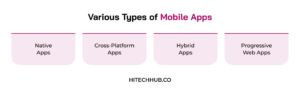
Native apps
Native apps are built for a particular platform, like iOS or Android, as they use different languages specific to the platform, which include Swift and Kotlin. They achieve the best performance, the best possible user experience, and full access to device functionalities.
-
Cross-platform apps
They are developed using one piece of code or framework, such as Flutter or React Native, which is then compiled into two individual applications for iOS and Android. Cross-platform app development achieves native-level performance and is quicker to develop than creating two native apps separately.
-
Hybrid apps
These platforms run in a native shell by using web technologies, such as HTML, CSS, and JavaScript, and tools like Cordova or Ionic. The main benefits are development and cost, as well as how rapidly an app can be launched, but hybrid applications aren’t as smooth as native or cross-platform apps.
-
Progressive Web Apps
This is not an application but a website that looks and feels like an app, including features like offline access and home-screen settings. They are relatively cheap to build and are a rapid way of getting your app to users, though still limited to web capabilities.
| Parameter | Native Apps | Cross-Platform Apps | Hybrid Apps | Progressive Web Apps (PWAs) |
| Development approach | Separate codebase for each operating system | Single codebase across multiple platforms | Web code wrapped in native container | Web application running through browser |
| Performance | Fastest performance with native hardware access | Near-native performance for most applications | Moderate performance with plugin dependency | Good performance with browser limitations |
| User experience | Best platform-specific user experience available | Consistent experience across different platforms | Basic interface with limited native feel | Responsive web-like experience across devices |
| Development cost | Highest development and maintenance costs | Lower costs through shared codebase | Cost-effective with web development technologies | Lowest development cost using web technologies |
| Best use cases | High-performance, feature-rich mobile applications | Business apps targeting multiple platforms | MVPs and budget-conscious application projects | Content-driven apps requiring broad accessibility |
Key Steps to Develop a Mobile Application
In this section, we will study the mobile app development process that targets multiple stages, from planning to execution. These steps are common and are widely accepted by experts, allowing you to make changes.
-
Ideation & market research
To develop a mobile app, you must research target users, available gaps in the market, and what competitors offer. This is the stage where you check whether the problem your app may solve is real or whether there is an actual demand before allocating budget to any resources. In most of the cases, skipping this phase results in an app that looks good on screen, but no one is actually using it.
-
Defining requirements & choosing a platform
After validating your idea, you must specify functional requirements, main features, and specifications for the app. During this stage, the decision of using native, cross-platform, or hybrid development language is taken depending on your budget and target users. Properly defining scope during this stage will avoid expensive alterations and misunderstandings during later parts of the development phase.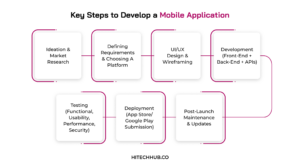
-
UI/UX design & wireframing
This phase converts every requirement into a visual design, user flows, and interactive prototypes that will illustrate the structure of the app. The main goal of UI designers is to ensure easy navigation, accessibility, and a coherent visual design based on the brand identity.
Designing the perfect prototype at this phase will ensure developers work with a perfect reference and will avoid later adjustments.
-
Development (front-end + back-end + APIs)
In this stage, the developers create the UI and integrate it with back-end technology and the actual business processes. Here, APIs are added to connect any required third-party payment gateways, services, and other integrations with back-end processes. Continuous back-end & front-end integration must take place throughout this development to see an app as one functioning piece.
-
Testing (functional, usability, performance, security)
Before submission, the app’s quality is tested through functional testing, compatibility testing, performance & load testing, and security testing to identify potential software errors.
These tests ensure the app works seamlessly in the hands of end users. Additionally, they focus on efficiency in a live production environment without system faults that may impact the user and company brand negatively.
-
Deployment (App Store/Google Play submission)
After the testing process, experts ensure compliance with functionality and user approval, allowing developers to prepare the submitted app against both the App stores’ policy guidelines. It is crucial to develop a suitable app store listing of relevant screenshots, content, and other media. Proper deployment enhances smooth installation & improved rankings in the market.
-
Post-launch maintenance & updates
Once the app is live, an ongoing maintenance programme, new OS version upgrades, and fixes for bugs or usability enhancements must take place. Update the content, keep engaging the users with analytics, and let the next generation of users focus on the iterative process. It ensures a seamless market release and changes features immediately to beat the market competition.
Key Mobile App Technologies & Tools in 2026
A business investor must be aware of a mobile app tech stack, which includes key technologies and tools. They help mobile app engineers to build advanced platforms from scratch with proper testing and security. Here we will look at the following table to understand them effectively.
| Technology Component | Popular Tools & Technologies (2026) |
| Frontend development | Flutter, React Native, SwiftUI, Kotlin Multiplatform |
| Backend development | Node.js, Django, Spring Boot, .NET Core |
| Database management | PostgreSQL, MongoDB, Firebase Firestore, MySQL |
| Cloud & backend services | AWS, Microsoft Azure, Google Cloud Platform, Firebase |
| AI & machine learning | OpenAI API, Google Gemini, TensorFlow Lite, ML Kit |
| DevOps & CI/CD | GitHub Actions, GitLab CI/CD, Jenkins, Bitrise |
| Analytics, testing & monitoring | Firebase Analytics, Mixpanel, Appium, BrowserStack |
Common Challenges in App Development
To build a mobile app, you must know various challenges, such as security and budget, that influence the overall process. You are going to study major development issues with their respective solutions in this section.
1. Device fragmentation
This challenge occurs due to issues in hardware configurations, operating system versions, and manufacturer software variations.
Solution: It is crucial to use fluid grids, constraint-based layouts, and scalable typography with a UI rendering layer.
2.Budget/timeline overruns
Unidentified requirements, integration complexities, and unrealistic estimations affect the budget specifications and timeline.
Solution: Businesses should create MVPs, adopt agile methodology, and implement change control to adjust to market demand.
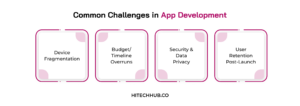 3. Security & data privacy
The major reasons include weak user authentication, insecure APIs, and inadequate data encryption, increasing security risks.
Solution: The use of hardware-driven storage options like iOS Keychain or Android Keystore with token-based validation is beneficial.
4. User retention post-launch
It is caused by complicated onboarding, slow performance, and market failure, reducing the number of users due to a delayed experience.
Solution: Enterprises must decrease login steps and allow users to test features, tracking errors in real-time and fixing bugs.
Cost of Mobile App Development
The mobile app development cost is variable and dependent on multiple factors, such as location, complexity, and platform. The overall price ranges from $20,000 to $200,000 and is influenced by increments and decrements of these factors. Let’s explore the table below to get an estimate of the current market cost for developing a mobile app.
| Cost-Affecting Factor | Estimated Cost (USD) |
| App complexity | $20,000–$200,000 (Basic to enterprise-grade applications) |
| Team hiring model | $15,000–$80,000 (Freelancers, in-house teams, or development agencies) |
| Design rates | $5,000–$30,000 (UI/UX research, wireframes, and visual design) |
| Security charges | $5,000–$25,000 (Encryption, authentication, compliance, and security testing) |
| Maintenance cost | $4,000–$20,000/year (Bug fixes, updates, monitoring, and feature enhancements) |
| Developers’ experience | $20,000–$120,000 (Junior, mid-level, senior, or specialist developers) |
| Location choice | $20,000–$150,000 (Costs vary by development region and labor rates) |
Best Practices for a Successful App
Businesses can hire mobile app developers who suggest various methods for making a smart and user-centric mobile app. Here are some important best practices that you must know before investing in the process.
-
Start with an MVP
MVP allows you to test out your core concept on your first set of users before you make a huge financial and time investment into a full-stack application. Businesses can save time and money in the long run by getting real feedback on their initial concepts.
-
Prioritize UX
A clean and intuitive UI with usability stands out between a deleted and a used app, which is essential for people to feel good while operating it. You must use simple navigation design and speed up the page loading time for a rich user experience and engagement.
-
Plan for scalability
Scalability ensures your application is prepared for exponential growth in user base and transactions.
This decision of system architecture and technological infrastructure is used, but developing it would prevent you from losing the investment in the long run.
-
Continuous testing & feedback loops
Frequent testing throughout the process and post-launch of the development cycle allows you to catch and repair bugs and usability issues. This task must be done before releasing the app for your end-users and also incorporate this together with user feedback.
In a nutshell!
Businesses must follow the right strategy and a flawless approach to create a mobile app that ensures long-term growth, user engagement, and increased ROI. It is important to bring your conceptual idea into existence with product evolution, platform maintenance, and compliance testing.
So, browsing verified mobile app development companies on our platform will help you to speed up market launch and ensure user security.
FAQs
How long does it take to build a mobile app?
On average, the time for developing mobile apps with basic features ranges from 2 months to 4 months. As the complexity increases, the timeline also rises to 8 months or more due to AI integrations and advanced technologies.
Native or cross-platform — which should I choose?
The selection of a mobile platform is dependent on project requirements, budget needs, and user demands. Businesses can choose native apps if the budget is high and you want to target a specific audience, but cross-platform is beneficial for both iOS and Android.
How much does it cost to develop a mobile app?
The development cost of a mobile application is between $20,000 and $60,000 for a simple-featured platform. It may increase to $200,000 because of more innovations in features and functionalities across devices or operating systems.
What is an MVP and why does it matter?
MVP (minimum viable product) is a basic prototype that includes core features, which allows early customers to use them. It is important because businesses can save money, test ideas fast, and understand users’ real-time preferences.
How do I choose the right app development company?
A dedicated process to hire a mobile app-making company is discussed in the following manner:
- Understand market and business goals.
- Review portfolios and case studies.
- Conduct technical interview sessions.
- Analyze ethical skills and credibility.
- Finalize experts and discuss the project.

Eshika Jain
31-July-2026
Top Categories

NEED HELP SELECTING A COMPANY?
With the fast-paced world of web development today, keeping pace.
Connect With Us