How Long Does It Take to Develop an App: Timeline and Factors
Have you ever questioned why one application releases in just eight weeks, whilst another releases more than a year later? The truth behind this lies in multiple aspects, from the feature set and platform to the level of expert developers and regulations.
For any business looking to develop a successful app, a good understanding of these determinants is not just convenient, but it is critical in preparing expectations and budgeting.
This guide explains how businesses can estimate the mobile app development timeline and complexity, outlines each phase of the process, and covers various factors that can delay the project. Whether you’re creating a basic MVP or a complex enterprise application, you’ll acquire a practical understanding of how long does it take to develop an app prior to launch.
Average App Development Timeline: A Quick Overview
Before you build a mobile app, it is crucial to know the average duration of the complete process based on different app requirements. From MVP to enterprise-level platforms, this section covers various mobile app types, each having a custom app development timeline. The following table explains specific use cases related to each factor, helping businesses to understand better.
| App Type | Timeline | Example Use Case |
| Simple App (MVP) | 6 – 12 weeks | Basic to-do lists or a habit tracker application |
| Basic App | 3 – 5 months | A restaurant ordering or appointment booking app |
| Medium-Complexity App | 5 – 8 months | Fitness tracking platforms with wearable integration |
| Complex App | 8 – 12 months | An on-demand ride-sharing or delivery platform |
| Enterprise-Grade App | 12+ months | Healthcare apps with HIPAA compliance and EHR integration |
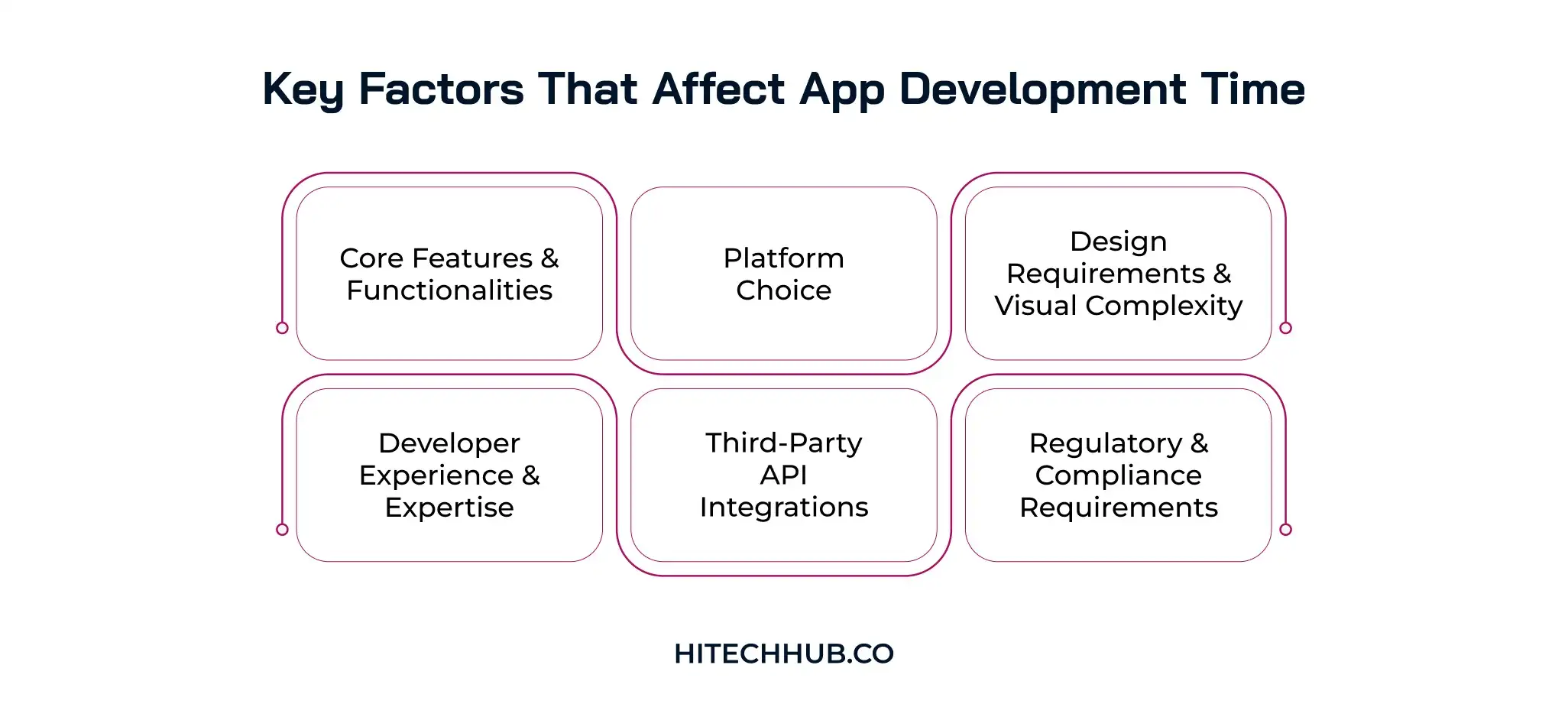
Key Factors That Affect App Development Time
App features, platform selection, and API integrations are the key factors affecting app development time. Some of the most crucial points are discussed in this section, with their respective parameters.
1. Core Features & Functionalities
The complexity of the features will heavily affect the building time of the app, as every feature has its own cycle of design, build, and test. An app with high-functionality features that require the development of real-time chat, AI, and complex algorithms will take longer than an app with basic or ordinary features.
- Feature Count: More features mean more development and testing time.
- Feature Complexity: Advanced logic-based features require deeper technical work.
- Custom vs. Standard Features: Custom-built features take longer than pre-built modules.
2. Platform Choice
As natively developed apps need different code for each of the platforms, iOS or Android app development time is longer than hybrid solutions. Cross-platform frameworks help to speed up the process but may require fine-tuning for each operating system.
- Native Development: Building separately for iOS and Android doubles development effort.
- Cross-Platform Frameworks: Tools like Flutter or React Native can reduce the overall timeline.
- Platform-Specific Testing: Each platform requires its own testing and optimization cycle.
3. Design Requirements & Visual Complexity
Mobile app design requirements, which can range from low-level layouts and components to custom animated interactions, also impact the development time. It requires deep UX research, custom design, or advanced animations, which can consume longer design and implementation efforts.
- Design Complexity: Custom animations and interactions extend the design phase.
- Number of Screens: More app screens require more design and development hours.
- Design Iterations: Multiple rounds of feedback and revisions can delay timelines.
4. Developer Experience & Expertise
A team’s skill and experience will affect the app development time to a large extent, as experienced developers can forecast problems and write understandable code. Less experienced teams may face a lot of bugs, rework, and delays during the entire development process.
- Technical Proficiency: Skilled developers complete tasks faster with fewer errors.
- Problem-Solving Ability: Experienced teams resolve technical roadblocks more efficiently.
- Familiarity with Tech Stack: Prior experience with chosen tools speeds up execution.
5. Third-Party API Integrations
Many apps require external services for payment gateways, Google Maps integration, or social media login, which can increase time if API configuration and documentation are lengthy. As the number of mobile integrations increases, the testing time required to ensure reliability also rises.
- Number of Integrations: More third-party services mean more integration and testing work.
- API Documentation Quality: Poorly documented APIs slow down implementation.
- Compatibility Issues: Ensuring integrations work smoothly across platforms takes extra time.
6. Regulatory & Compliance Requirements
Apps that follow various regulations, like HIPAA for healthcare or ADA for Accessibility, add further time and testing stages required for compliance. These standards require special documentation, security measures, and special testing methods prior to the launch.
- Industry-Specific Regulations: Healthcare, finance, and legal apps require extra compliance work.
- Data Security Standards: Ensuring encryption and privacy compliance adds development time.
- Accessibility Requirements: Meeting ADA or WCAG standards requires additional testing cycles.
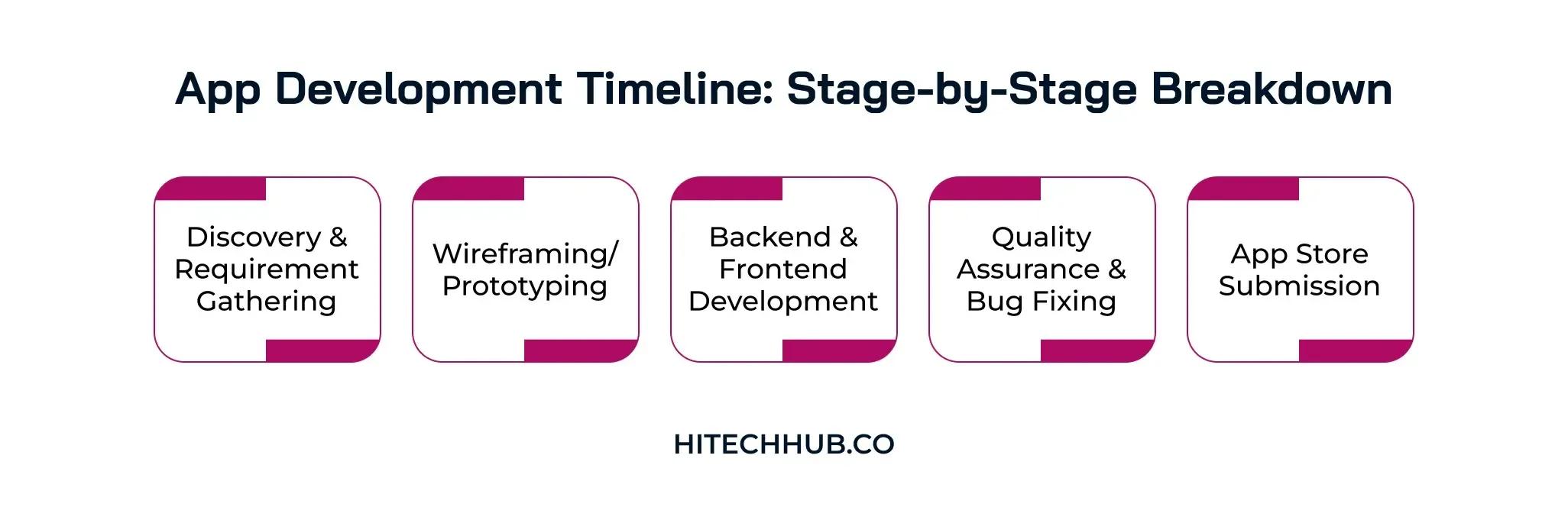
App Development Timeline: Stage-by-Stage Breakdown
The time is also influenced by the app development process, which includes planning, integration, and deployment. We will study the impact of these steps on the overall duration through their specific points.
1. Discovery & Requirement Gathering
In this first phase, the application objectives, target users, primary functionalities, and technical requirements are precisely identified without any implementation. An effective planning phase helps to avoid costly changes in the project and determines the correct development approach.
- Business Goal Alignment: Clarifies the app’s purpose and desired business outcomes.
- Technical Feasibility Analysis: Assesses which features are realistically achievable within budget and time.
- Project Scope Documentation: Creates a detailed outline of features, timeline, and deliverables.
2. Wireframing/Prototyping
This is a crucial stage where designers make low-fidelity wireframes and interactive prototypes that help to make platform structure, flow, process, and navigation. These will provide early feedback on mobile application features as well as understanding needs before the main design stage.
- User Flow Mapping: Outlines how users will navigate through the app’s screens.
- Low-Fidelity Wireframes: Establishes basic layout structure without visual detail.
- Interactive Prototype Testing: Validates usability and gathers early stakeholder feedback.
3. Backend & Frontend Development
This is one of the major mobile app development stages where developers produce the actual code for the app’s functionality, database, and user interface. Backend development can handle server logic, databases, and APIs, while frontend development ensures user interaction with animations and other elements.
- Database & Server Setup: Establishes the infrastructure that stores and manages app data.
- API Development: Builds the connections that allow the app to communicate with backend services.
- UI Implementation: Converts design mockups into a functional, interactive interface.
4. Quality Assurance & Bug Fixing
QA testers are involved in mobile app testing across a wide range of devices and platforms, reducing Android or iOS app development time. They identify numerous bugs, performance issues, or usability problems in the application before launch, which provides a good user experience and functionality.
- Functional Testing: Verifies that all features work as intended.
- Performance Testing: Checks app speed, stability, and responsiveness under load.
- Cross-Device Compatibility: Ensures consistent performance across different devices and screen sizes.
5. App Store Submission
After beta testing, the mobile app can be deployed on the Apple App Store and/or the Google Play Store, where it can be easily reviewed and published online. Here, businesses need to closely read through the requirements of both of the platforms to avoid rejection and delays.
- Platform Guideline Compliance: Ensures the app meets Apple and Google’s submission requirements.
- Metadata & Listing Optimization: Prepares app store descriptions, screenshots, and keywords.
- Review & Approval Process: Involves waiting for platform review before the app goes live.
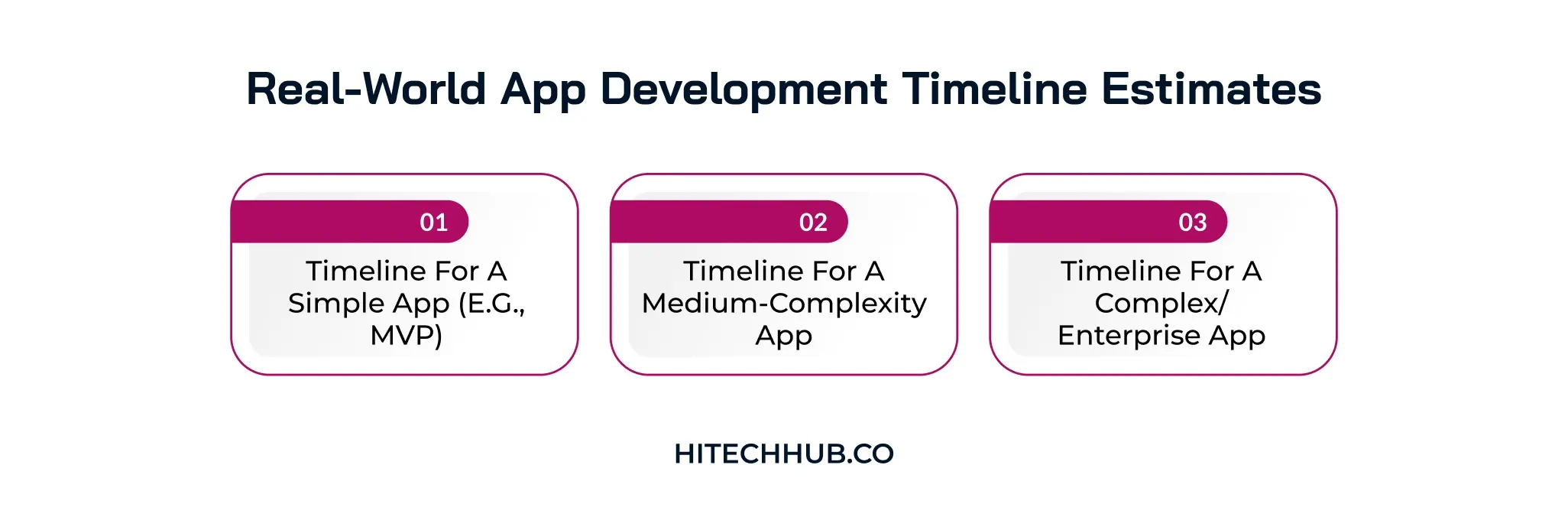
Real-World App Development Timeline Estimates
Mobile app complexity is one of the major reasons that affect the app development timeline, as we have studied briefly. In this section, we will go a bit deeper and understand important app levels that affect the duration.
1. Timeline for a Simple App (e.g., MVP)
The MVP development timeline does not include advanced features and complex integration, only focusing on core functions. By using an MVP in mobile apps, enterprises can present their idea to real customers and gain feedback before investing in a full-scale product.
- Limited Feature Set: Focuses only on essential, must-have functionalities.
- Minimal Design Complexity: Uses simple, functional UI without extensive customization.
- Faster Market Validation: Enables quick user feedback before further investment.
2. Timeline for a Medium-Complexity App
Mobile apps with medium complexity contain features like user authentication, third-party integration, and custom design work, which influence the overall timeline. An effective testing process is required for these platforms, as the number of linked feature sets and workflows increases.
- Multiple Core Features: Includes several functional modules beyond basic MVP needs.
- Third-Party Integrations: Requires connecting external services like payments or maps.
- Custom UI/UX Design: Involves more detailed design work than a simple app.
3. Timeline for a Complex/Enterprise App
The development time for enterprise-level solutions depends on advanced mobile app functionalities, high scalability needs, and strict regulatory compliance. These platforms require a larger and specialized team with extensive testing to ensure security, performance, and reliability.
- Advanced Functionalities: Includes features like AI, real-time data, or complex algorithms.
- High Scalability Needs: Built to support large user bases and heavy traffic loads.
- Compliance & Security Requirements: Requires additional development for regulations like HIPAA or GDPR.
How to Speed Up App Development Without Compromising Quality?
A business investor needs to understand the scope, use pre-built components, and automate workflows to speed up the app development lifecycle with accuracy. This section describes key metrics that help enterprises focus on process elements, such as implementing faster APIs, using React Native or Flutter, or adhering to strict app store guidelines.
Lock the Scope: Entrepreneurs must define core features, user roles, and future goals to prevent scope creep.
Use Pre-Built SDKs/APIs: They must integrate trusted third-party APIs for login or payment instead of building custom solutions.
Adopt a Modular Architecture: Breaking the codebase into smaller modules helps teams to work independently.
Set Up CI/CD Early: Use CI/CD pipelines to automate development and deployment tasks from the start.
Automate Testing: Run automated tests for functions and user flows to catch bugs without slowing down release cycles.
In-House vs. Outsourced Development: Which Is Faster?
Choosing between in-house vs outsourced app development is crucial for an enterprise, whether small-scale or large-scale, to ensure seamless development and integration. With this consideration, it is beneficial for businesses to easily develop an iOS app or an Android app for the target user base. To understand the differences clearly, we are discussing key parameters in the following table.
| Parameter | In-House Development | Outsourced Development |
| Speed of Development | Slower, limited by existing team size and bandwidth | Faster, with access to larger, specialized teams |
| Cost | Higher due to salaries, benefits, and infrastructure | Lower, with flexible pricing models and no overhead costs |
| Communication | Easier, real-time collaboration within the same location | May involve time-zone differences and communication gaps |
| Talent Availability | Limited to locally hired or existing staff | Access to a global pool of specialized experts |
| Scalability | Harder to scale quickly for larger projects | Easier to scale team size based on project needs |
How to Choose the Right Development Partner for Faster Delivery?
Businesses should hire app development companies based on certain metrics like agile methods, portfolio experience, and transparent communication. It is essential to review past projects and conduct direct interviews to determine the technical knowledge and ethical skills of a team. Let’s study some crucial points that help to understand how to select the right partner for faster delivery.
- Ensure Agile Strategies: The experts are able to break projects into smaller modules for better monitoring and performance tracking.
- Examine Relevant Portfolio: The agency must have developed similar platforms, ensuring faster project initialization.
- Evaluate Work Experience: Focus on hiring experienced developers to prevent project delays and management errors.
- Test Communication and Responsiveness: The service provider must deliver quick communication to avoid poor project alignment.
- Start a Small Pilot Project: Test their delivery speed and problem-solving skills by starting a small pilot project
Conclusion!!
The mobile app development timeline can vary, from a couple of weeks to develop a simple MVP to over a year for a more advanced and enterprise-level product. Some key factors include the complexity of features, platform choice, experience of hired developers, and compliance regulations. Once a business clearly understands how long does it take to build an app, it is easy for them to set realistic budgets and estimations.
Additionally, they can reduce expensive delays in development and make informed decisions for hiring teams, whether in-house or an outsourcing company. To find an agency that can release the app in the market efficiently, Hitech Hub is the best place for enterprises to compare and select teams.
FAQs
How Does the App Development Timeline Impact the Total Project Budget?
The time to develop a mobile app may increase the labor hours, resource fees, and overhead costs. Variables like software licenses, cloud hosting, and project management are responsible for increasing both the mobile app development cost and timeline. A longer duration may allow for new feature requests or changing requirements but affects the financial estimates.
How Much Time is Needed for Ongoing App Maintenance After Launch?
The average time required for mobile app maintenance ranges from 2 weeks to 4 weeks per year, or 5% of the overall duration. Weekly tasks like bug fixes and server checks may take 2 to 5 hours per week, whereas monthly tasks like performance reviews may take 1 to 2 weeks per year. System upgrades and feature additions may also affect the total time for developing mobile apps.
How Does the Choice Between Native and Cross-Platform Impact the Timeline?
The cross-platform app development timeline is shorter than native platforms because a single codebase is used to build apps for both iOS and Android. It ensures a faster launch by reusing code and handling updates or bugs, which reduces unnecessary delays. For native apps, businesses need specialized developers, enhanced quality assurance (QA), and store approval cycles.
What are the Most Common Causes of Project Delays During App Development?
It is crucial for businesses to know various reasons that can delay the app development project timeline. Some of the major causes are discussed for better understanding:
- Ambiguous Requirements: Unclear project goals may lead to increased overhead, wasted work, and heavy redesigns.
- Poor Communication: Siloed teams, missing user feedback, or delayed project updates can affect the timeline.
- Resource Constraints: A lack of skilled developers, testing devices, or project management tools slows down the process.

Eshika Jain
10-September-2026
Top Categories

NEED HELP SELECTING A COMPANY?
With the fast-paced world of web development today, keeping pace.
Connect With Us