Mobile App Maintenance Cost Explained: Factors, Pricing & Savings Tips
Launching your own mobile application is a significant step, but it is only the beginning of your journey. An application needs regular updates and improvements to stay relevant, whereas product value, pricing, and user adoption guarantee substantial revenue. This maintenance process involves addressing bugs, enhancing user experience, increasing customer engagement, and improving the application’s performance.
The costs connected to this process can often be ignored during mobile app development, which can result in adverse financial outcomes for the company. In order to avoid such a scenario, it is essential to understand the importance of mobile app maintenance costs and keep a realistic budget for the project.
Here, you will study key cost factors, pricing benchmarks, regional rates, and practical savings tips. It will allow business investors to plan a maintenance budget and execute it properly.
What is Mobile App Maintenance?
Mobile application maintenance is a post-development activity that is performed after an app has been launched to users. It is an ongoing process that involves monitoring security, updating for new iOS and Android versions, fixing bugs, and improving mobile app performance. Many businesses only invest to build a mobile application, but they overlook security and maintenance. With regular app maintenance, businesses can improve their product ratings, retention, and revenue.
Maintenance vs. Updates vs. New Feature Development
Businesses may choose between maintenance, updates, or new feature addition for a mobile application based on their project specifications. Each one of them serves a different purpose, affecting the overall budget and timeline. By understanding these differences, it will be easy to plan investments, set clear priorities, and avoid unnecessary expenses.
| Parameter | Maintenance | Updates | New Feature Development |
| Purpose | Keeps the existing app stable, secure, and running without issues. | Refreshes the app to match new OS versions and standards. | Adds brand-new capabilities that expand what the app can do. |
| Trigger | Bug reports, crashes, security risks, and ongoing performance monitoring needs. | Triggered by new iOS or Android releases and library changes. | Driven by user feedback, market demand, and business growth goals. |
| Frequency | Continuous and recurring, usually handled through monthly support or retainers. | Periodic releases, typically quarterly or after major platform changes. | Planned as separate one-time projects within the product roadmap. |
| Cost Pattern | Predictable yearly spend, typically 15-20% of original development cost. | Moderate, variable cost depending on how significant the changes are. | Higher, project-based cost depending on feature scope and complexity. |
| User Impact | Users notice fewer crashes, faster speeds, and better reliability. | Users get compatibility, security fixes, and small interface improvements. | Users gain new functions that improve engagement and retention. |
Types of Mobile App Maintenance
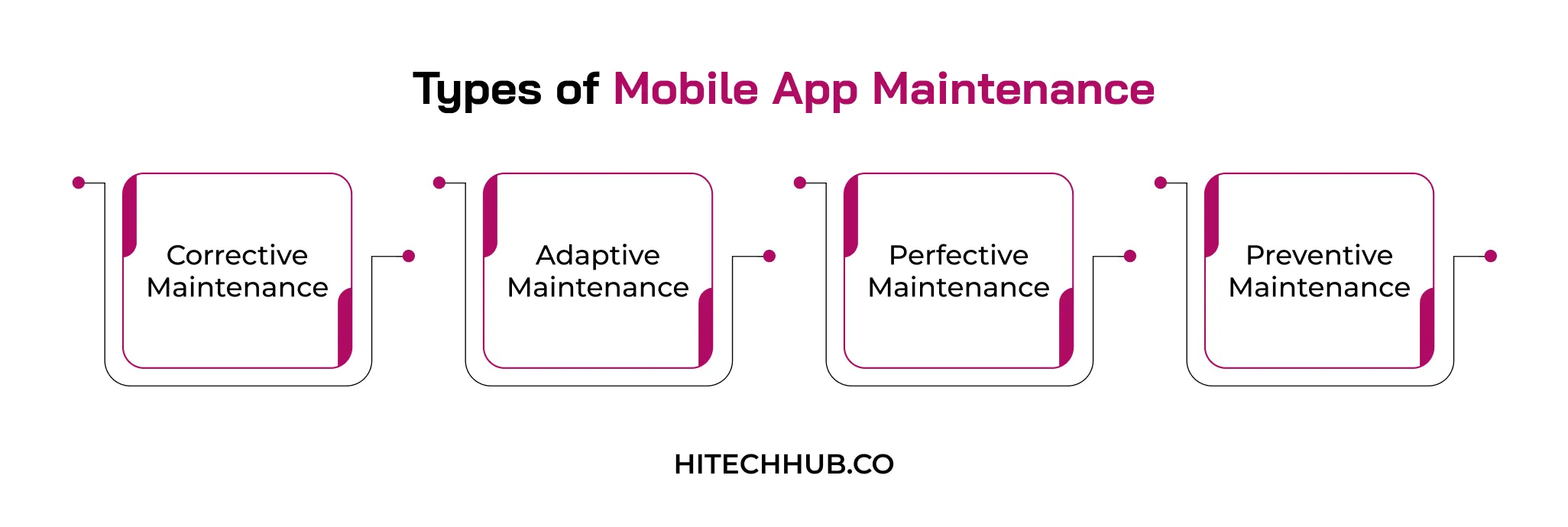
There are 4 major types of mobile app maintenance approaches that work differently based on the tasks provided. By knowing them, you can easily allocate budget and prioritize real-time app requirements.
1. Corrective Maintenance
Corrective maintenance fixes various bugs, crashes, and errors that users report or that monitoring tools detect after launch. Additionally, it restores normal app function quickly by protecting mobile app ratings, retention, and user trust across test cases.
2. Adaptive Maintenance
Adaptive mobile app maintenance services update the app so it keeps working with new iOS and Android versions, devices, screen sizes, and third-party APIs. It also prevents compatibility issues that could break multiple features or get the app removed from stores.
3. Perfective Maintenance
Perfective maintenance improves existing features by making the app faster, easier to use, and more polished, based on user feedback and analytics. This model allows businesses to focus on overall user engagement and satisfaction without adding major new functionality.
4. Preventive Maintenance
Preventive maintenance addresses problems through code refactoring, security patches, dependency updates, and regular performance checks. It may affect the timeline to develop an app by lowering technical debt and the risk of costly emergency fixes.
How Much Does Mobile App Maintenance Cost?
Most businesses know that maintenance charges are a fixed percentage of the development cost. It is necessary for a startup or new investor to have a realistic mobile app maintenance checklist. In this section, we will understand the benchmark, monthly and yearly budgets, and how complexity affects the cost.
1. The 15–20% Rule Explained
This rule states that the annual cost of maintaining a mobile app is approximately 15% to 20% of the original development budget. An overload of custom code leads to increased chances of bugs, more third-party software dependencies to update, and more testing for OS updates. If the development cost of a mobile app is $100,000, then it requires $15,000 to $20,000 to remain secure, compatible, and reliable.
In the first year after launch, this rule breaks, as mobile app maintenance can cost up to 50% of the initial development cost, according to industry estimates. This is because of heavy post-launch bug fixing, user-feedback adjustments, and initial platform stabilization. The range shifts towards the standard rate once everything gets stable.
2. Average Monthly and Yearly Maintenance Cost
Now, you have understood that the app maintenance cost per year ranges from 15% to 20% of the total development expenses. Most businesses also calculate average monthly cost to track minor changes in app complexity, platform, integrations, and hosting services. These estimates help them to plan budgets efficiently for simple apps that need minimal ongoing support and feature-rich apps that require continuous attention.
3. Maintenance Cost by App Complexity
App features, integrations, and user base affect the cost to build an app, but they also influence the maintenance effort and expenses. The following table represents 5 different mobile app complexity levels with estimated annual and monthly maintenance costs.
| Complexity Level | Annual Cost | Monthly Cost | Description |
| Basic App | $6,000 – $15,000 | $500 – $1,250 | Few screens, static content, minimal backend and integrations. |
| Moderate App | $15,000 – $30,000 | $1,250 – $2,500 | User accounts, push notifications, and a few integrations. |
| Feature-Rich App | $30,000 – $54,000 | $2,500 – $4,500 | Real-time chat, payments, geolocation, and custom admin dashboards. |
| Complex App | $54,000 – $84,000 | $4,500 – $7,000 | Many integrations, large user base, and frequent releases. |
| Enterprise App | $84,000 – $120,000 | $7,000 – $10,000 | AI features, strict compliance, heavy traffic, round-the-clock support. |
Key Factors That Affect Mobile App Maintenance Cost
Like development rates, the cost to maintain a mobile app also depends on several factors, such as platform choice. These points explain how maintenance budgets vary and where businesses can make changes.
1. App Features and Functionality
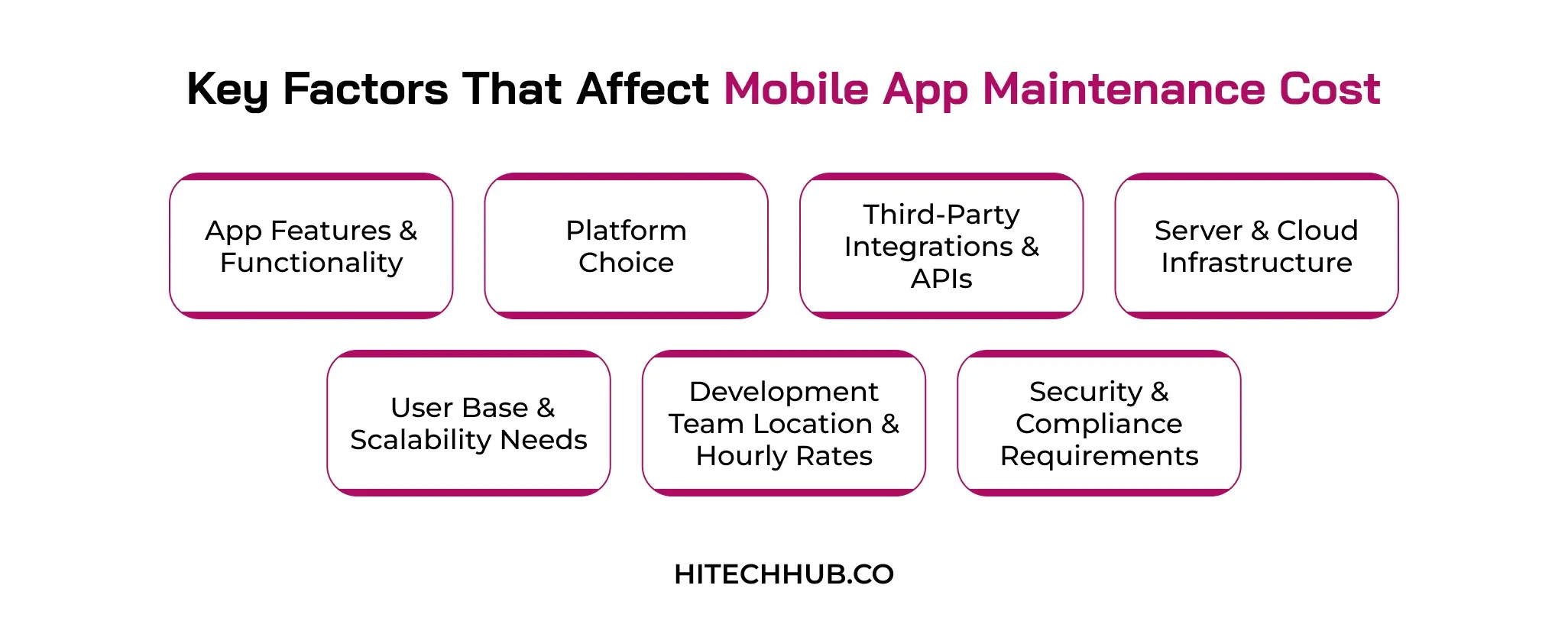
Every feature, such as in-app payments, chat, geolocation, or AI tools, adds its own bug risks and update needs in the mobile application. The more advanced the functionality, the more testing, ongoing support, and monitoring the app requires.
2. Platform Choice
Android apps need testing across many devices and OS versions, while iOS apps must pass App Store review and meet Apple’s guidelines. Cross-platform frameworks like React Native or Flutter share one codebase, which can reduce duplicate effort.
3. Third-Party Integrations and APIs
Payment gateways, maps, and social logins depend on external providers who may update or retire their APIs, so developers need to track announcements. These integration services need constant monitoring and timely code updates to avoid broken app features.
4. Server and Cloud Infrastructure
The hosting setup you choose, whether shared servers or cloud platforms like AWS and Google Cloud, shapes how much management your backend needs. Complex architectures require more monitoring, optimization, and technical expertise.
5. User Base and Scalability Needs
A growing user base puts more load on servers, databases, and support teams, increasing the iOS and Android app maintenance cost. Apps expecting rapid growth need regular performance tuning and scaling work, which raises ongoing maintenance effort.
6. Development Team Location and Hourly Rates
Developer rates vary widely by region, from budget-friendly markets to premium ones like North America and Western Europe. The experience level of mobile app experts and time-zone overlap also affect the final maintenance cost for businesses.
7. Security and Compliance Requirements
A mobile app support and maintenance company can support compliance with regulations like GDPR or HIPAA, but it depends on the data, organization, product, and jurisdiction. Meeting these rules calls for regular audits, documentation, and updates that increase maintenance spending.
Breakdown of Mobile App Maintenance Costs
In this section, we are going to focus on the mobile app maintenance cost breakdown that depends on various parameters. Businesses spend money based on the following services monthly or annual after launch.
1. Bug Fixing and Technical Support
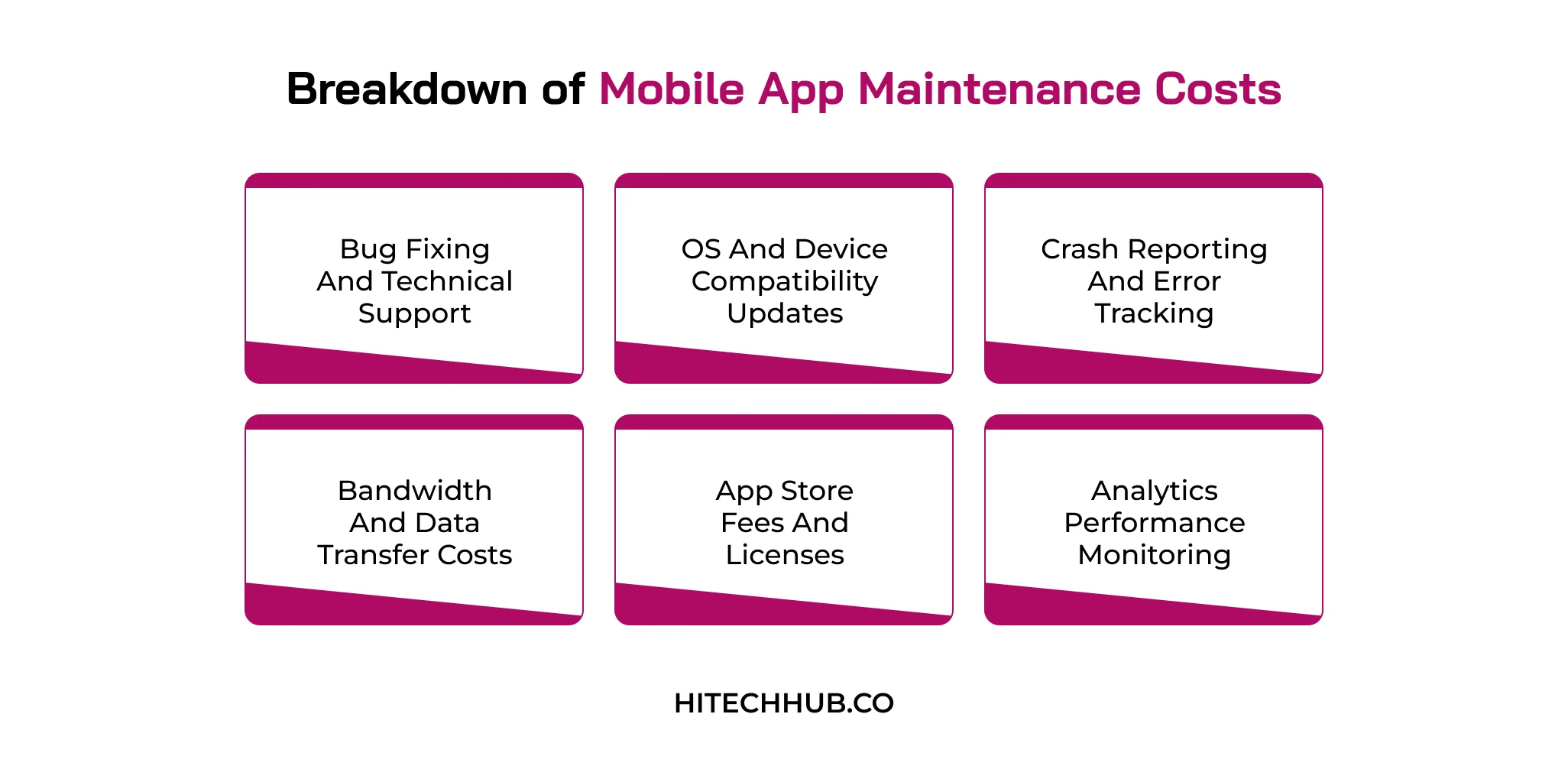
This covers identifying, reproducing, and resolving errors that are reported by experts or caught during testing. Ongoing technical support keeps response times short and prevents small system issues from turning into bigger maintenance expenses.
2. OS and Device Compatibility Updates
Each new platform update or release, along with new devices and screen sizes, requires constant testing and code adjustments. By analyzing the Android and iOS app maintenance cost of various devices, you can keep the app working smoothly for every user.
3. Crash Reporting and Error Tracking
Various tools like Firebase Crashlytics and Sentry capture crashes and errors instantly or after arrival, helping developers locate causes quickly. They charge subscription fees and require developer time to review reports that make up this recurring cost.
4. Bandwidth and Data Transfer Costs
The downloading of multiple files, images, videos, and API calls uses network bandwidth, allowing cloud providers to charge for data transfers. This cost increases as your user base grows, so it is necessary to optimize media and enable caching to control it.
5. App/Play Store Fees and Licenses
Apple App Store charges $99 per year, and Google Play Store charges a one-time $25 fee for creating a developer account. The choice between iOS or Android app development depends on paid SDKs, third-party libraries, and software licenses, adding recurring costs.
6. Analytics Performance Monitoring
Several mobile app analytics and monitoring tools track load times, user behavior, and app health so teams can identify issues at early stages. Additionally, paid plans for these platforms and time spent analyzing data add to monthly spending.
Hidden Costs of App Maintenance Most Businesses Overlook
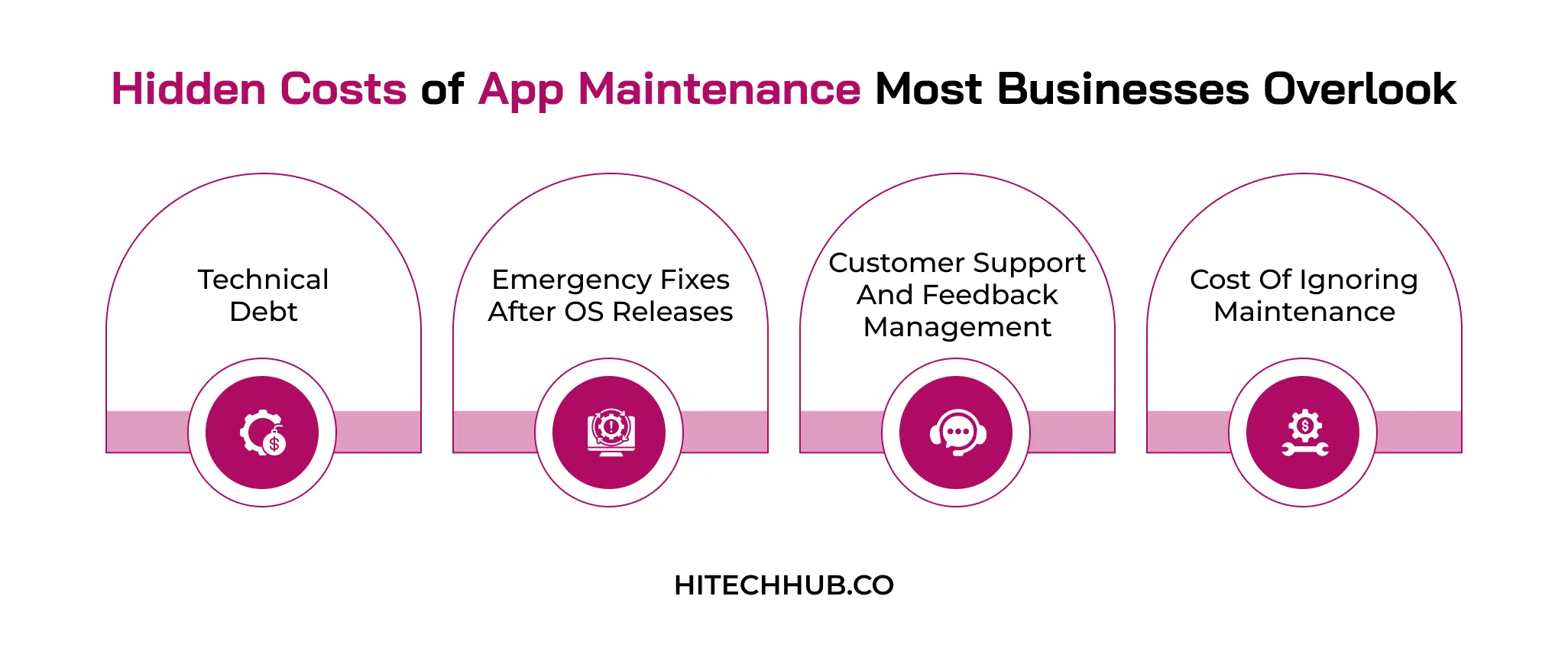
Other than routine fixes, several expenses are not mentioned in initial quotes and can affect the overall cost model. By recognizing hidden costs of app maintenance, it is easy to prevent unexpected changes and plan a realistic budget.
1. Technical Debt
Quick fixes and rushed code during development create hidden problems that make every future update slower and more expensive. Over time, this debt forces costly rewrites and increases the risk of unexpected bugs, affecting quality and performance.
2. Emergency Fixes After OS Releases
Major Android and iOS app development releases can suddenly break layouts, permissions, or features, forcing urgent unplanned work. These rush fixes often cost more than scheduled updates because they require immediate developer attention.
3. Customer Support and Feedback Management
Responding to user complaints, reviews, and support tickets increases staff time that rarely appears in maintenance practices. Tracking feedback also helps teams to identify recurring bugs before they damage app store ratings and mobile app maintenance cost.
4. Cost of Ignoring Maintenance
Skipping mobile application updates may lead to frequent system crashes, security gaps, poor reviews, and users switching to competitors. If the experts fix a poorly maintained app later, it will cost far more than keeping it functional from the start.
Mobile App Maintenance Cost by Region
The location of support teams affects the cost to maintain a mobile app based on hourly rates, communication quality, and response times. Whether you hire app development companies in the USA or other regions for app launch and maintenance, it affects the cost according to the needs and teams’ expertise. In this section, we will discuss 10 different regions, showing hourly rates and the key cost-driving factors.
| Region | Hourly Maintenance Rate | Key Cost Drivers |
| North America | $60 – $100 | High developer salaries, strong talent demand, premium for time-zone alignment, strict compliance needs |
| South America | $30 – $60 | Moderate salaries, favorable US time-zone overlap, growing talent pool, currency fluctuations |
| Western Europe | $55 – $100 | High labor costs, GDPR compliance requirements, strong local regulations, experienced senior talent |
| Eastern Europe | $30 – $65 | Skilled engineers, balanced salary levels, strong technical education, EU market proximity |
| East Asia | $35 – $75 | Advanced tech ecosystem, high demand for developers, language barriers, specialized platform expertise |
| India & South Asia | $15 – $40 | Large talent pool, lower living costs, high competition among agencies, time-zone differences |
| Southeast Asia | $20 – $45 | Affordable labor, fast-growing tech hubs, varied skill levels, emerging outsourcing demand |
| Middle East Region | $40 – $80 | Rising tech investment, reliance on imported talent, premium agency pricing, regional compliance rules |
| African Region | $20 – $50 | Emerging talent market, lower salaries, limited senior specialists, infrastructure and connectivity costs |
| Australia/New Zealand | $55 – $95 | High cost of living, small talent pool, strong data privacy laws, premium for local support |
In-House Team vs. Outsourced Maintenance
Hiring a team for maintaining mobile apps affects communication, speed, and control, influencing the choice. Businesses can focus on app maintenance cost estimation by comparing both approaches along with the pricing models in this section.
1. Pros and Cons of an In-House Team
By hiring in-house developers, businesses get greater control, but it also limits skills and creates recruitment challenges. The table below discusses major pros and cons of hiring an in-house team for maintaining mobile apps.
| Advantages | Limitations |
| Full Control—Direct oversight of priorities, timelines, and quality standards for updates. | High Fixed Costs—Salaries, benefits, and equipment create expensive year-round overhead expenses. |
| Deep App Knowledge—Team members understand the codebase, speeding up bug fixes significantly. | Hiring Difficulty—Finding and retaining skilled mobile developers takes time and effort. |
| Faster Communication—Same-office collaboration allows quick decisions and immediate issue resolution. | Limited Skill Range—Small teams may lack expertise in security, DevOps, or testing. |
| Dedicated Availability—Dedicated staff remains available for urgent fixes during critical situations. | Dependency Risk—Losing one key developer can disrupt maintenance and delay releases. |
2. Pros and Cons of Outsourcing to an Agency
Product teams can partner with an app maintenance agency that offers flexible pricing and specialist skills in native or hybrid, but it raises security concerns. They can explore the following table to understand key advantages and limitations of this model.
| Advantages | Limitations |
| Lower Costs—Pay only for needed services, avoiding salaries, benefits, and equipment. | Less Control—Daily priorities and workflows depend heavily on the agency’s schedule. |
| Broader Expertise—Access specialists in security, testing, DevOps, and multiple platforms instantly. | Communication Gaps—Time zone differences and language barriers can slow issue resolution. |
| Scalable Support—Easily increase or reduce resources as maintenance workload changes. | Security Concerns—Sharing source code and user data requires strong contractual safeguards. |
| Faster Onboarding—Established teams and processes start work within days, not months. | Vendor Dependency—Switching agencies later can be costly without proper documentation handover. |
3. Common Pricing Models
Various agencies charge for updates and feature enhancements based on the following three app maintenance pricing models. By understanding them, enterprises can choose a payment structure according to the app’s needs.
Hourly Rate Model: It charges for the actual hours that developers spend on fixes and updates. It suits apps with unpredictable or occasional maintenance needs, but monthly bills can vary and are harder to forecast.
Monthly Retainer Model: Businesses pay a fixed monthly fee for a set number of support hours or a defined list of services. It gives predictable budgeting and priority support, though unused hours may not roll over.
Fixed-Price SLA Model: The fee is tied to a service level agreement that spells out covered tasks, response times, and uptime targets. It offers cost certainty, but work outside the agreed scope is billed separately.
How to Reduce Mobile App Maintenance Cost
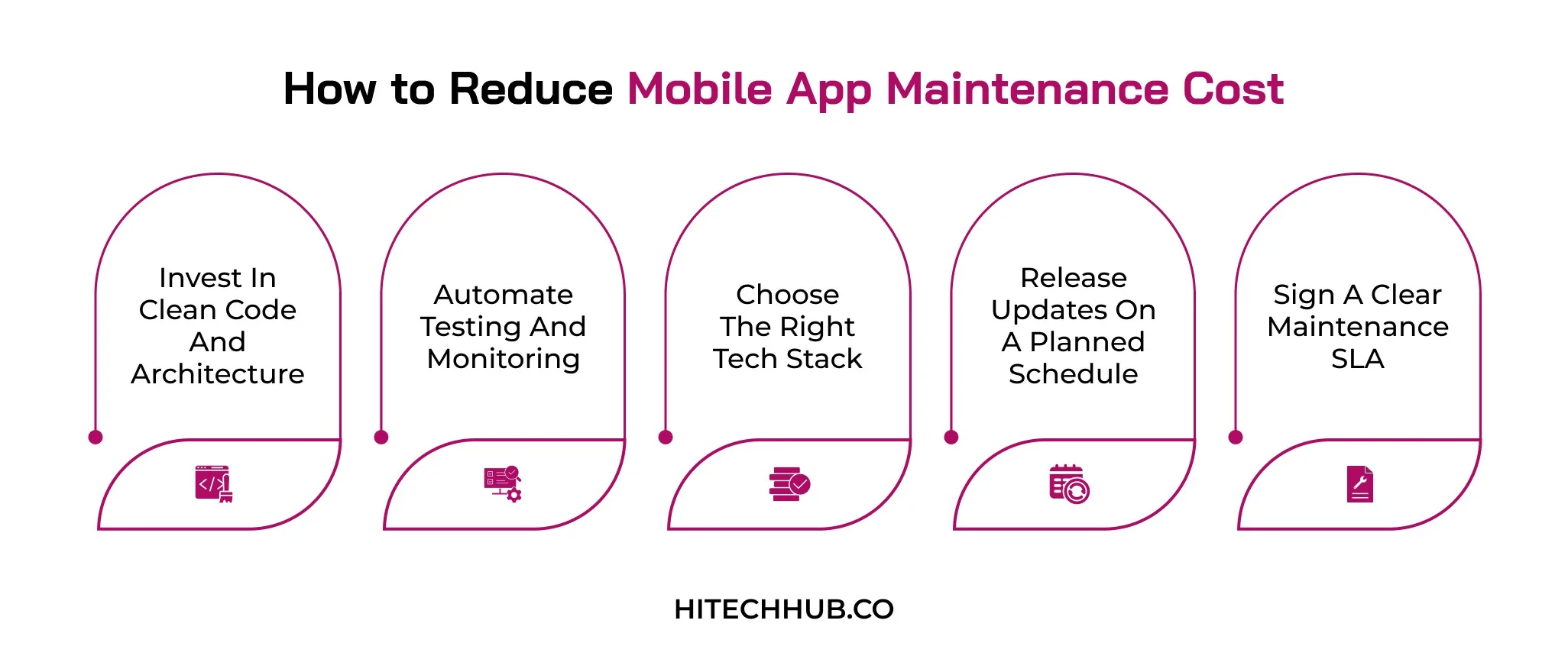
With smart planning, enterprises can decrease mobile app maintenance costs without sacrificing quality. These strategies help to control expenses, reduce emergency fixes, and keep the app stable for the long term.
1. Invest in Clean Code and Architecture
Well-structured and documented code is easier to read, debug, and update, which reduces the developers’ time that they spend on the bug-fixing process. A modular architecture also lowers the risk of changes that can affect the quality of other features.
2. Automate Testing and Monitoring
Automated mobile app testing and real-time monitoring allow experts to catch bugs and performance drops before users notice them. This reduces manual testing hours and prevents expensive emergency fixes after the application launch.
3. Choose the Right Tech Stack
Skilled and reliable developers help businesses to find advanced and innovative technologies and keep current dependencies on track. Additionally, cross-platform frameworks like Flutter and React Native can also reduce effort by maintaining a single codebase.
4. Release Updates on a Planned Schedule
The addition of fixes and improvements into regular release cycles is cheaper than rushing individual vulnerability patches. A predictable schedule also helps teams to easily plan for testing, avoid last-minute work, and lower the app maintenance budget.
5. Sign a Clear Maintenance SLA
With a service level agreement, product teams can define response times, covered tasks, and pricing, which may prevent several additional charges and system failures. An SLA gives them predictable and manageable monthly costs, considering the maintenance partner is accountable.
When Should You Plan the Maintenance Budget?
The mobile app maintenance cost must be planned before launch, so it will be easy to handle issues later. It helps to protect the roadmap, avoid unnecessary expenses, and get funds for real-time updates and fixes.
-
During the planning phase
It is important to plan for maintenance at the initial planning stage to prevent unnecessary changes and costs after going live. By estimating ongoing expenses for iOS, Android, or Flutter app development at all phases, it will be easy to choose the right tech stack and team structure. Additionally, it allows businesses to prevent financial losses and ensures budget management during first mobile app updates.
-
Reserve a maintenance fund
Product teams should keep a fixed amount as the annual app maintenance cost from the overall app budget. It helps them to implement new features, manage OS updates, and resolve security issues after launch. Businesses can hire experts to review and adjust changes as the user base, features, and infrastructure continue to grow.
How to Choose the Right Maintenance Partner
It is highly recommended to approach a reliable partner for estimating the cost to maintain a mobile app. Enterprises must know the following points to evaluate the agencies before signing any agreement.
Verified Reviews and Portfolio: Check reviews and case studies to confirm the agency has maintained similar apps, including an MVP for mobile app launches.
Clear SLA Terms: Look for written agreements that define covered tasks, response times, escalation steps, and penalties for missed deadlines.
Fast Response Time: Choose a team that guarantees quick replies and resolves critical issues within the deadline, providing support across your time zone.
Strong Security Practices: Confirm the agency follows secure coding standards, signs NDAs, and protects your source code and user data properly.
Transparent Pricing: Prefer partners who provide itemized quotes and clear billing, so you avoid hidden charges and unexpected budget increases.
Conclusion
Mobile app maintenance is not an optional expense but a core part of keeping your product secure, competitive, and profitable. Although it rarely appears as a separate point in the initial project documentation, so businesses should plan and budget for it from the start.
The complexity level, development platform, third-party services, and the team’s location impact the final price. So it is crucial to plan this expenditure and set aside a dedicated budget.
With proper app maintenance and support services, you can establish a predictable cycle of updates and bug fixes without experiencing extra costs. Are you looking for experienced app developers who can help you maintain your mobile app? Explore the Hitech Hub directory and find an agency for your business today.
Frequently Asked Questions (FAQs)
-
What is included in mobile app maintenance services?
Mobile application maintenance provides ongoing technical support, updates, and monitoring, ensuring functional and compatible apps after launch. Major services include bug fixing, device updates, performance optimization, and feature refactoring. Additionally, backup and reporting are also performed by experts to maintain the security of mobile apps.
-
Why is mobile app maintenance important after launch?
Maintenance is crucial after launch because user expectations, operating systems, and security threats change constantly. Apps without maintenance suffer from multiple crashes, slow performance, and low user retention. It allows apps to match OS compatibility, ensure data protection, increase savings, and optimize app store visibility.
-
Is mobile app maintenance cost different for iOS and Android apps?
Generally, mobile app maintenance expenses range from 15% to 20% of the original development cost. But it differs for both iOS and Android mobile application platforms based on App Store fees, review cycles, and device fragmentation. The cost to maintain an iOS app is from $8,000 to $25,000+ per year, whereas for Android it is from $7,000 to $22,000+ per year.
-
How can I reduce my mobile app maintenance cost?
With targeted architecture, automation, and infrastructure adjustments, businesses can reduce the maintenance cost of mobile apps. They can conduct app audits, automate testing, and use the right cloud infrastructure for cost reduction. Additionally, it is beneficial to implement third-party APIs, utilize cross-platform frameworks, and follow proactive preventive maintenance.

Eshika Jain
14-October-2026
Top Categories

NEED HELP SELECTING A COMPANY?
With the fast-paced world of web development today, keeping pace.
Connect With Us