MVP in Mobile App Development for Startups: An Implementation Guide
Millions of dollars and months of development time are invested by startups each year into making brand new, full-stack mobile applications, only to find users don’t want what they’ve built.
This is the risk that an MVP (Minimum Viable Product) avoids, as it helps businesses to focus on a lean and functional product that people will actually want.
MVP in mobile app development prevents them from investing precious resources and capital into developing customized platforms in the initial phase that may or may not connect with actual market interests.
For the startup, the limited money and time mean the MVP development approach isn’t just a convenient strategy, but it is crucial for success. It can be the difference between bringing a product into existence that people want and burning your assets on assumptions.
This blog explains how modern and small-scale startups can build their mobile app MVPs. It also provides insights on key features, cost, common mistakes that businesses make, and best practices in detail.
What is an MVP in Mobile App Development?
An MVP is a functional version of a mobile app, which includes essential features required to solve specific problems and test the business idea.
It focuses on primary app elements that initial customers can use and give feedback accordingly. In minimum viable product software development, businesses can reduce expenses, validate market demand, and gain a competitive edge.
-
Comparing MVP, Prototype, and POC
This section differentiates between an MVP, a prototyping model, and the POC (Proof of Concept).
| Parameter | POC (Proof of Concept) | Prototype | MVP |
| Purpose | Tests technical feasibility internally | Visualizes design and user flow | Validates product-market fit externally |
| Audience | Internal team and stakeholders | Internal team and select testers | Real users in the market |
| Functionality | Minimal, non-functional, or basic | Clickable but non-functional demo | Fully functional, core features |
| Outcome | Confirms the idea is technically possible | Refines design before development | Gathers real user feedback data |
-
Key Metrics for MVP in Developing Mobile Apps
The metrics in developing a mobile app minimum viable product (MVP) focus on validation, user value, and cost-efficiency. They include the following points:
- Retention rate: It measures the number of users who return to your app in different time frame intervals, such as day 1, day 7, and day 30. It reflects whether your MVP is solving a real problem that people need, and a lack of retention indicates reduced value or a usability issue.
- Activation rate: It tracks what percentage of users perform a critical action, such as completing onboarding or making their first purchase. A healthy activation rate ensures that users aren’t just installing but interacting with the feature.
- Customer Acquisition Cost: CAC measures the money spent on sales and marketing to acquire new users to see if the growth is financially sustainable. This allows startups to optimize acquisition channels before investing in an unstructured strategy that is potentially unstable.
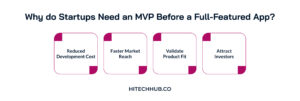
Why do Startups Need an MVP Before a Full-Featured App?
Building an MVP helps enterprises to understand whether their idea is unique or not, know market trends, and manage expenses. Some of the major advantages of creating MVPs for mobile apps are discussed in this section.
1. Reduced Development Cost
If you build an MVP, you will only spend money on the essential features, not build a whole app that may be rejected by users. With a lean strategy, the start-up saves the little money that they have at the early stage and has a product launched on the market.
2. Faster Market Reach
The MVP removes optional functionality and helps you launch complete iOS or Android apps much quicker than a full-stack product. It will help them to secure their space in the market while other companies are still developing the full app.
3. Validate Product Fit
Launching an MVP allows the startup to receive feedback from real users on whether their core features are true, instead of assumptions and best guesses. If the product can address real problems for the target consumers, then people will purchase it without thinking.
4. Attract Investors
An MVP provides proof of concept, comprising actual users, data usage, and consumer interest, which is powerful to investors as compared to a PowerPoint presentation of a product/service idea. The evidence-backed traction from an MVP gives more validity to the product idea.
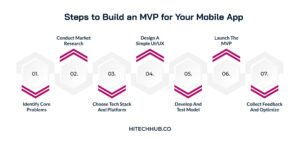
Steps to Build an MVP for Your Mobile App
An enterprise can initiate MVP development by following a commonly used process that involves several stages. From the problem statement to feedback collection, we will study every crucial step in this section.
-
Identify Core Problems
Start by clearly identifying the problem statement and demonstrating how the app will solve these issues by focusing on specific use cases.
Now, enterprises can easily make choices by defining clear business goals that will form the basis of all mobile application features and design. With this, they can communicate their concept to developers, investors, and early users without misunderstanding.
-
Conduct Market Research
Research the target audience, competitors, and the current gaps in the market to determine the existence of actual consumer demands.
Experienced MVP development companies help study how other apps have succeeded with users and the value they offer. With advanced innovations, an existing app often covers more features in your respective field.
-
Choose Tech Stack and Platform
Businesses can create MVPs for iOS, Android, or both and choose a tech stack for mobile apps that enables faster development, scalability, and cost efficiency.
Investors choose cross-platform technologies like Flutter for MVPs to reduce development costs through a single codebase. This also affects the long-term product roadmap, since switching tech stacks later can be costly and time-consuming.
-
Design a Simple UI/UX
It is important to develop a simple mobile app interface that allows users to perform various tasks without any distraction. Enterprises must not over-design at this level, as the primary goal is to build a functional and user-friendly product, not an end product.
Wireframes and low-fidelity designs might suffice to evaluate usability prior to moving to higher-fidelity.
-
Develop and Test Model
The development of the main features involves an agile sprint model where features are built and tested step-by-step with proper research. Various testing methods during this step, covering functionality, performance, and security, help to find bugs before they compound into bigger issues.
This development strategy ensures stability and availability of the mobile app MVP for production use.
-
Launch the MVP
Once development and testing are done, rather than releasing the MVP to the public, release it to a smaller segment of a specific market.
Doing so through a soft launch ensures performance testing in a live environment, identifies last-minute bugs or fixes, and gains initial feedback without reducing the brand value. It helps to reduce various risks, allowing businesses to make necessary changes before scaling up.
-
Collect Feedback and Optimize
Once live, collect user feedback via surveys, analytics, reviews, and direct feedback to discover what is suitable for your audience.
Use this information to decide on the next set of iterative improvements that help to enhance the user experience. Entrepreneurs can fix usability problems, implement advanced features, and improve existing ones to transform their MVP into a product.
Must-Have Features for a Successful MVP App
For building a minimum viable product, it is beneficial to know various features that are selected in the initial stages. Here, you will observe the key components of a mobile app MVP through the following table.
| Must-Have MVP Feature | Description |
| User Registration & Login | Enable users to create accounts and securely access the app through email, phone, or social login. |
| Simple & Intuitive UI | Provide a clean interface that makes core features easy to discover and use. |
| Core Functionality | Include only the essential features that directly solve the target users’ primary problem. |
| User Profile Management | Allow users to view and update their personal information, preferences, and account settings. |
| Search & Navigation | Help users quickly find relevant products, services, content, or app functions with intuitive navigation. |
| Push Notifications | Send timely updates, reminders, alerts, and personalized messages to keep users engaged. |
| Feedback & Support | Give users simple ways to report issues, share feedback, or contact customer support. |
| Analytics & Reporting | Track user behavior, engagement, and key performance metrics to guide future product improvements. |
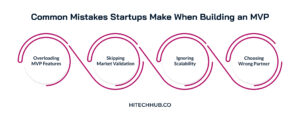
Common Mistakes Startups Make When Building an MVP
While developing an MVP, businesses can make multiple mistakes due to a lack of knowledge or support. So, this section discusses some of the major points that every investor must know before development.
-
Overloading MVP Features
Most entrepreneurs try to fit the entire vision of their startup into their first MVP, totally underestimating the idea of a minimum viable product. This causes delays, raises the cost, and complicates the question of which one of the features is responsible for driving or influencing customer engagement.
-
Skipping Market Validation
Some entrepreneurs jump directly into the building process, assuming customer needs without validating the actual market demand among users. This can result in a well-built mobile application that nobody actually needs, wasting both time and early-stage funding.
-
Ignoring Scalability
Multiple start-ups design MVPs for iOS applications that are faster and cost-effective, settling on a rigid architecture that doesn’t perform well after gaining momentum. This can make the rebuild experience stressful, expensive, and slow when the team requires product scaling.
-
Choosing Wrong Partner
Most businesses hire affordable teams instead of finding an experienced development partner with enhanced skills and proven technical knowledge. This can lead to missed deadlines, poor code quality, and an inefficient product that doesn’t align with the startup’s actual goals.
MVP Development Cost Estimate for Startups in 2026
The MVP development cost typically ranges from $5,000 to $50,000, depending on multiple parameters, such as design, APIs, testing, and security.
There are more factors, like app complexity, development location, and platform choice, which affect the total investment. Enterprises build a mobile application by studying each factor, its respective costs, and timelines.
The following table discusses everything that is crucial for creating effective minimum viable products.
| Development Parameters | Cost Range | Average Timeline |
| UI/UX Design Complexity | $5,000 – $15,000 | 2–4 weeks |
| Backend & Database Architecture | $8,000 – $25,000 | 1–2 months |
| Testing & Quality Assurance | $5,000 – $12,000 | 2–3 weeks |
| Post-Launch Support & Maintenance | $6,000 – $20,000 | 1–3 months |
| Security & Compliance Requirements | $10,000 – $30,000 | 1–2 months |
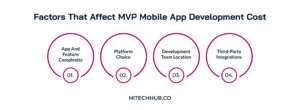
Factors That Affect MVP Mobile App Development Cost
The cost of building MVP apps is heavily influenced by several market factors, such as complexity and API integrations. In this section, we focus on key parameters and their impact on the overall cost of app-making.
-
App and Feature Complexity
Various advanced features, such as real-time data sync, complex algorithms, and custom animations, increase development costs and the workload involved. Simpler, single-function apps with basic processes will be less expensive than apps with complex workflows or diverse users.
-
Platform Choice
Investing in Android or iOS app development will take longer and is more expensive because it requires coding separately unless experts use a cross-platform framework. Going with native apps means businesses are doubling their workload, while hybrid languages offer reasonable cost-per-platform and device coverage.
-
Development Team Location
MVP software development companies in North America and Western Europe would charge more than outsourcing teams in India, Southeast Asia, and Eastern Europe. Location not only influences the hourly rate of the development teams but also the experience, communication levels, and past projects.
-
Third-Party Integrations
Most third-party services like payment gateways, maps, push notifications, or CRM increase the development time and cost due to custom API configuration.
Various proxy tools have their own licensing or subscription fees, which can add to the overall project budget beyond just development hours.
Best Practices for Building a Startup MVP
It is important to follow some necessary practices for making effective MVP apps with core features and technologies. They help entrepreneurs to analyze progress and make changes based on user feedback.
-
Ensure Small Integrations
Limit third-party integrations in the MVP model by using only the necessary tools for the core features, reducing overall expenses and complexities. A lean setup means less time spent on coding and less chance of technical glitches during your first few trials.
-
Prioritize User Experience
The MVP should be intuitive even though the features are limited because users can leave easily if the website navigation is complicated. Businesses should design a simple user interface with React Native or Flutter to get valuable product insights and prevent usability issues.
-
Set Clear KPIs to Measure Success
It is crucial to decide on Key Performance Indicators (KPIs) that can easily align with the product’s success, such as retention, activation rate, and user engagement time.
These parameters provide the necessary data to determine how to move forward by iterating, pivoting, or scaling services.
When to Move from MVP to Full-Scale App Development?
As MVP app development helps you to understand overall cost, product value, and future goals, a full-scale product allows market reach.
Businesses must know the right moment when they can easily migrate from MVP to the end platform.
In this section, we will explore some crucial points that will help in a seamless transition.
- The active user base grows weekly, and the retention rate increases.
- People can use core features and suggest more advanced ones.
- Consumers show interest in subscription and other revenue models.
- The MVP code fails or run slow during higher user traffic.
- Businesses have resources and budgets to scale the whole product.
Conclusion!!
Building a minimum viable product isn’t about launching an incomplete platform, but it is about releasing in the market with smart strategies.
By focusing on MVP development services, validating real market demand, and making iterative improvements, entrepreneurs can easily lower market risks. Additionally, they can easily reduce expenses while developing mobile apps that connect with their target audience.
A carefully designed MVP builds a firm foundation for continued expansion and progress, even when you are testing a new idea or just updating an existing strategy. Hiring trustworthy mobile app development companies in the USA through Hitech Hub may significantly affect your chances.
FAQs
How Long Does it Take to Build MVPs?
The time required for creating small-scale MVPs ranges from 1 month to 2 months due to a single workflow. The timeline for SaaS-based mobile platforms is between 2 and 4 months because of advanced integrations. With security and AI-powered features, the overall duration may increase to 6+ months.
What’s the Difference Between an MVP and a Beta App?
An MVP validates a business idea, caters to user preferences, is released at an early stage, and has vital features. A beta application helps to identify bugs, has almost complete features, comes before launch, and ensures stability. MVPs focus on a smaller group, whereas beta apps are tested with a large group of people.
How to Test and Measure MVP Success?
Businesses can easily measure the success of an MVP through the following process:
- First, it is crucial to define business goals and target issues.
- Enterprises should choose key metrics for data transparency.
- Use tracking tools to track activities and monitor engagement.
- Deliver the rollout model to specific user profiles for consistency.
- Get feedback and match it with the ideal conditions to get results.
Should a startup build an MVP for iOS, Android, or both?
A startup should not focus on native platforms like Android or iOS for developing MVP models. It should implement cross-platform frameworks, such as Flutter and React Native, to launch on both platforms.
This ensures budget efficiency and reduces additional technology expenses due to a single codebase.

Eshika Jain
31-August-2026
Top Categories

NEED HELP SELECTING A COMPANY?
With the fast-paced world of web development today, keeping pace.
Connect With Us