How to Choose The Right Technology Stack for Mobile Apps?
Two companies release practically identical apps on the same day. After a year, one has its entire ecosystem melting down due to bugs and endless load times, turning its million-user success into a liability, while the other is scaling effortlessly.
Not the marketing, not the idea, not some fortunate circumstance, but the key was the technology. Selecting a successful and efficient technology stack is not only important, but it is essential to ensure whether or not your app can last or be buried under a pile of trouble.
We shall analyze it to identify the issue and help ensure your selected application stack is successful in helping your business grow in the market. So, let’s jump into this blog and grab valuable information.
What is a Mobile App Technology Stack?
A tech stack includes multiple programming languages, frameworks, libraries, datasets, and tools, helping developers to build and run mobile applications.
It is known as the foundational blueprint that helps to determine the functioning of both the user-facing side and the behind-the-scenes server infrastructure. Here, we are observing a quick introduction to different tech stack components and tools.
-
Core Components of a Mobile App Tech Stack
A tech stack for developing mobile applications includes various components and tools. They are described in the following table:
| Component | Common Tools & Technologies |
| Frontend Framework | Flutter, React Native, SwiftUI, Kotlin, .NET MAUI |
| Backend Framework | Node.js, Django, Spring Boot, ASP.NET Core, Laravel |
| Database | PostgreSQL, MySQL, MongoDB, Firebase Firestore, Redis |
| Cloud & Hosting | AWS, Google Cloud Platform (GCP), Microsoft Azure, Firebase |
| APIs & Integrations | REST APIs, GraphQL, Stripe, Twilio, Google Maps API, Firebase Authentication |
| DevOps & CI/CD | Docker, Kubernetes, GitHub Actions, GitLab CI/CD, Jenkins |
| Monitoring & Analytics | Firebase Analytics, Google Analytics, Crashlytics, Sentry, Datadog |
-
Native vs. Cross-Platform vs. Hybrid Apps
We are observing the key difference between native, cross-platform, and hybrid development approaches. The table below helps us to understand key parameters:
| App Type | Popular Tools & Frameworks |
| Native Apps | Swift, SwiftUI, Objective-C (iOS), Kotlin, Java, Jetpack Compose (Android) |
| Cross-Platform Apps | Flutter, React Native, .NET MAUI, Kotlin Multiplatform (KMP), NativeScript |
| Hybrid Apps | Ionic, Apache Cordova, Capacitor, Framework7, Onsen UI |
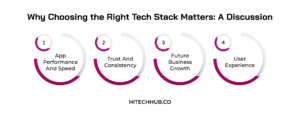
Why Choosing the Right Tech Stack Matters: A Discussion
It is crucial to know the role of a tech stack for business investors before using various tools and technologies. This section discusses some key points about why it is crucial to select the right tech stack.
-
App Performance and Speed
The right tech stack dictates how well your application performs in terms of loading speed, response times, and operations, especially in situations of heavy usage. A bad tech stack will make your application perform slowly, break constantly, or lead to excessively long load times, resulting in loss of customers.
-
Trust and Consistency
A carefully selected tech stack will ensure your application is consistent regardless of the devices, OS, or network capabilities your user utilizes. This cultivates a stronger, more trustworthy, and positive experience with mobile app users while building a more reliable and efficient image.
-
Future Business Growth
As the number of users increases, the mobile app complexities also rise because of integrated frameworks. A scalable tech stack will allow your application to integrate new features in real-time and support growing data volumes without the need for a complete re-architecture.
-
User Experience
The tech stack impacts the user’s experience and usage patterns due to interface technologies. It can also affect how intuitive, streamlined, and enjoyable using your app is from a user’s point of view, as it is a key contributor to user retention and satisfaction.
Key Factors to Consider Before Choosing a Tech Stack
Businesses must be aware of a few important factors that help in the selection of a suitable tech stack. These elements, from application type to security, lay a foundation for effective mobile app development.
1.Type of App
Whether it is e-commerce, social media, healthcare, or enterprise business solutions, the technology used for creating an app entirely depends on these types.
So make sure that the technology stack fits into the requirements of the mobile app functionality, the performance level it needs, and also industry standards.
2. Target Platform
Before choosing a technology stack, decide on what platform the app will be available, including web and mobile platforms, like Android and iOS. Native, web, and cross-platform technologies have unique pros and cons, including cost, speed of development time, and ease of maintenance.
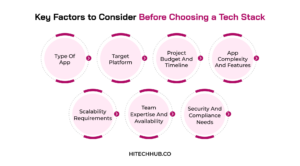
3. Project Budget and Timeline
Both budget and timeline often define the choice of technology stack, restricting businesses to choose only one platform. Utilizing cross-platform development technologies along with pre-finished tools for a faster start will save you money.
4. App Complexity and Features
If the application uses AI, AR/VR, or real-time chat functionality, it can be built upon using a solid and scalable framework. Selecting a stack capable of handling these functionalities ensures smooth performance and easier future enhancements.
5. Scalability Requirements
If you foresee rapid user growth, your technology should allow for horizontal scaling and have the option to reside on the cloud and rely on high-performance databases. It can start thinking about how your solution scales, saving costs down the road instead of a future costly migration.
6. Team Expertise and Availability
You should stick to technologies that your current team is proficient with or can understand quickly, minimizing any project risks and learning curves. A popular stack also makes hiring future developers much easier and maintenance over the long run simpler.
7. Security and Compliance Needs
If your application handles personal or financial data, then you must consider technologies with well-established security and compliance features and support. Ensure your chosen technology stack meets regulations such as the GDPR, HIPAA, or PCI DSS, where applicable.
Frontend Technologies for Mobile Apps
It helps developers to build user interfaces that offer smooth navigation, creative home page elements, and animated features. The major frontend tools and technologies are discussed in this section with their key uses.
-
Flutter
Google’s open-source UI framework for high-performance native Android and iOS development from a single codebase. Flutter also provides a wide variety of widgets, a quick development experience, and performance that is close to native platforms.
-
.NET MAUI
.NET MAUI (Multi-platform App UI) is Microsoft’s framework for building native mobile and desktop applications. With.NET MAUI, you can write a mobile app using C# that allows developers to share their codebase across different platforms and get a native and good performance.
-
Ionic
Various mobile apps can be built using hybrid frameworks such as Ionic by using HTML, CSS, and JavaScript in order to get one application to work on iOS and Android. It saves more development costs, as it only uses 1 language for creating user-centric mobile platforms.
-
SwiftUI
SwiftUI is Apple’s new and modern native declarative framework to build apps for iOS, iPadOS, macOS, watchOS, and tvOS. In addition, it has an intuitive layout language, an expressive design, and native performance elements.
Backend Technologies for Mobile Apps
The backend ensures database management, secure cloud storage, and enhanced API integrations. In this section, some of the major backend components are described that provide strong support to app design.
-
Choosing the Right Database (SQL vs. NoSQL)
It all depends on the nature of data your application handles, scalability, and database performance. SQL databases should be chosen for applications dealing with structured data, whereas NoSQL databases should be chosen for larger data volumes.
| Parameter | SQL Database | NoSQL Database |
| Data Structure | Uses structured tables with predefined schemas, making it ideal for relational data. | Stores flexible, schema-less data in documents, key-value pairs, or graphs for dynamic applications. |
| Scalability | Primarily scales vertically by increasing server resources for better performance. | Designed for horizontal scaling across multiple servers to handle massive workloads. |
| Best Use Cases | Best for banking, ERP, CRM, and applications requiring complex queries and ACID compliance. | Ideal for social media, IoT, real-time analytics, and high-traffic applications with unstructured data. |
-
Cloud Platforms (AWS, Firebase, Azure, Google Cloud)
A cloud hosting solution gives access to scalable servers, storage facilities, computing power, and deployment tools. Cloud infrastructure like AWS, Google Cloud, and Microsoft Azure helps make your application highly dependable by reducing infrastructure costs.
| Cloud Platform | Description |
| AWS (Amazon Web Services) | Offers the broadest range of cloud services with high scalability, global infrastructure, and enterprise-grade security. |
| Firebase | Google’s Backend-as-a-Service (BaaS) platform that simplifies app development with real-time databases, authentication, analytics, and hosting. |
| Microsoft Azure | Provides robust cloud services with seamless integration into the Microsoft ecosystem, making it ideal for enterprise applications. |
| Google Cloud Platform (GCP) | Delivers scalable cloud infrastructure with powerful AI, machine learning, data analytics, and Kubernetes support for modern applications. |
-
APIs and Third-Party Integrations
Mobile applications use third-party APIs for payment gateways, authentication services, and mapping data to integrate with the application. Various plug-ins make mobile app development faster and make sure it delivers an enhanced user experience, increasing user activity.
Native vs. Cross-Platform: Which One Should You Choose?
Native mobile applications are developed and customized for a single operating system, such as the iOS or Android ecosystem. By using SDK tools and their development languages, native apps offer enhanced performance, user-friendliness, and unrestricted access to APIs.
| Pros | Cons |
| Delivers the fastest speed and smoothest user experience by leveraging platform-specific optimization. | Separate codebases for iOS and Android increase development and maintenance expenses. |
| Provides complete access to hardware features like GPS, camera, Bluetooth, and biometrics. | Building and testing separate applications for each platform takes more time. |
| Follows platform-specific design guidelines for a seamless and intuitive interface. | Updates, bug fixes, and feature releases must be managed independently for each platform. |
Cross-platform apps use a single source of code for various operating systems, which reduces development costs and timelines for business investors. These apps are developed to match performance levels on their native platforms using tools such as Flutter and React Native.
| Pros | Cons |
| One codebase runs across multiple platforms, reducing development effort and simplifying maintenance. | May not match the speed and responsiveness of fully native applications for resource-intensive tasks. |
| Shared code significantly reduces development, testing, and long-term maintenance costs. | Some advanced device features require additional plugins or custom native code. |
| Simultaneous deployment on iOS and Android accelerates product launches and updates. | Long-term support and compatibility depend on the chosen framework’s updates and ecosystem. |
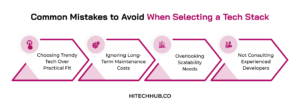
Common Mistakes to Avoid When Selecting a Tech Stack
Several investors overlook mistakes, like maintenance costs and scalability, while choosing a tech stack. Here, we will observe various aspects that enterprises must avoid during the development of mobile apps.
-
Choosing Trendy Tech Over Practical Fit
Choosing trendy but not suitable tech can cause many problems, such as performance, compatibility, or even maintenance. You should choose a tech stack focusing on your business goals, project needs, and AI-driven development.
-
Ignoring Long-Term Maintenance Costs
Regular mobile app updates, bug fixes for new vulnerabilities, and maintenance require additional investment. Therefore, when building a tech stack, it is crucial to think about ongoing costs and the sustainability of your future product.
-
Overlooking Scalability Needs
A website or web app built with a particular tech stack cannot handle an increasing number of users, data, or new features. This leads to significant rework, with limited resources and scalability, affecting the overall project value.
-
Not Consulting Experienced Developers
Poor technological choices by the developers can lead to bad architectural choices, higher costs of development, and technical debt. So, it is important to hire experienced IT-Consultants on your team to save lots of resources.
How to Choose the Best Technology Stack: A Step-by-Step Process
A dedicated process to choose the right tools and technologies is discussed in this section that investors must know. From planning to execution, you are going to study each step with key implementation strategies.
1. Define Business Objectives
Determine the core purpose of your application, understand who you’re building it for, and identify the business outcomes you want to achieve. The goals will allow you to choose a tech stack that matches the overall strategy and financial objectives of your product.
2. List Core Features
Build out a detailed list of all essential application functionality, such as payment processing, real-time chat features, or AI capabilities. This helps investors to make sure that the technology can seamlessly cover your functional demands.
3. Evaluate Technical Requirements
It is crucial to consider various factors like app performance, security, scalability, and compatibility with various third-party integrations. Data management policies and a hosting platform help to make sure you will future-proof your development plans.
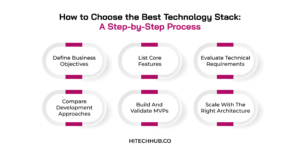
4. Compare Development Approaches
Based on the goals, budget, and timeline, you can easily compare native, cross-platform, and hybrid applications to determine which works best. By weighing their respective pros and cons, you can find which is the perfect app solution for your audience.
5. Build and Validate MVPs
Test all the basic features you are including, like user experience, product functionality, and market response, before releasing. That strategy is designed to mitigate many of the common development pitfalls and also make your decision-making process around technology more manageable.
6. Scale with the Right Architecture
From a technical perspective, you must know how this architecture will scale as your application usage and functionality increase. A sound application architecture will enable future development with minimal rework, which translates into both reduced maintenance time and costs.
Conclusion!!
The right tech stack is about strategy, not only technical expertise. This process plays a fundamental role in how the app functions, its ability to scale up, and its cost in the future. Companies need to look at this carefully in relation to their own set of needs, financial capability, and projected growth. Working with reputed mobile app development firms, such as the talent at HiTech Hub, will help them in making sure these decisions are aligned with the app objectives for today and in the future.
FAQs
What is the best tech stack for a startup mobile app?
A startup should use Flutter for the frontend, Node.js for the backend, and MongoDB for database management. By using cross-platform tools, the investors can easily reduce development costs and launch on both iOS and Android, increasing market reach.
Is Flutter better than React Native in 2026?
Flutter is used by 46% of developers, offering graphics-intensive and pixel-perfect UI experiences with an Impeller rendering engine. React Native has a share of 35% in the market and has higher annual maintenance costs due to its new architecture that provides Fabric, JSI, and Turbo modules.
How much does it cost to build a native mobile app?
The cost of making a native mobile app is dependent on platform choice, such as iOS and Android, which require separate codebases. The average price ranges from $20,000 to $300,000 based on project complexity, like basic, mid-sized, advanced, and enterprise-grade.
Can I switch tech stacks after development has started?
Yes, it is possible to switch between tech stacks during the development process, but it increases costs, risks, and delays. Businesses must change technologies only if the current tools are not capable of delivering core features and fulfilling safety needs.

Eshika Jain
08-August-2026
Top Categories

NEED HELP SELECTING A COMPANY?
With the fast-paced world of web development today, keeping pace.
Connect With Us